Month: December 2014

Poached eggs with smoked salmon and hollandaise sauce

IMG_0429

If you asked ten people what Eggs Benedict was, I am sure nine and a half of them would tell you it was poached eggs sitting on smoked salmon with hollandaise sauce.

Which is what happens when restaurants (and some food writers) are sloppy with their naming. A similar situation exists with Eggs Florentine.

Nevertheless, I just love eating this, whatever it is called.

4 thick slices of sourdough bread
Olive oil
1 clove of garlic (optional)
A generous quantity of smoked salmon
8 poached eggs (these can be poached in advance and reheated, as they would be in a restaurant situation)
Hollandaise sauce
Cayenne pepper (optional)
Sea salt and freshly ground black pepper
A sprig of dill or tarragon, to garnish

Brush both sides of the sourdough slices with a little olive oil and place under a hot grill for 1 – 2 minutes each side, until crisp and golden. Rub one side of each slice with the garlic clove.

Top each slice of sourdough with a generous quantity of smoked salmon, top the smoked salmon with 2 reheated and well-drained poached eggs. Spoon hollandaise sauce over the eggs.

Sprinkle with a little cayenne pepper if using, then season with sea salt and freshly ground black pepper.

Garnish with a sprig of dill or tarragon and serve immediately.

Serves 4.

Variation: Cook some spinach in a little butter to wilt, then chop finely. Transfer the spinach to a sieve and, using the back of a spoon, press out as much water as possible. Season the spinach with salt and freshly ground pepper and lemon juice to taste.

Top each slice of sourdough with the spinach, add the smoked salmon, the poached eggs, then the hollandaise sauce. Garnish as above.

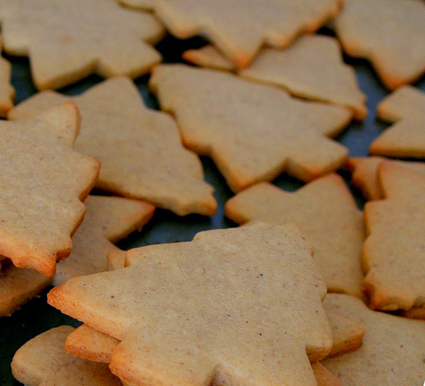
Almond Christmas Wafers

christmas almond wafers

185g butter, softened
250g caster sugar
1 teaspoon vanilla essence
2 eggs
250g plain flour, sifted
100g ground almonds

Beat butter, sugar and vanilla until creamy. Add eggs, one at a time, beating well after each addition. Gradually add the flour and almonds and mix to a firm dough. Wrap in plastic wrap and refrigerate for at least 3 hours, or until very firm.

Divide dough into 4 portions, roll out one portion 5mm thick and refrigerate the remainder until required. Using biscuit cutters in Christmas shapes cut out the dough (Christmas trees, angels, stars, etc.). Repeat with remaining dough.

Bake on a greased and lined baking tray at 180C for 10 – 12 minutes, or until golden.
Store in an airtight container. Dust some of the shapes with icing sugar before serving.

Layered Mascarpone and Berry Christmas Pudding

Layered Mascarpone and Berry Christmas Pudding

250g mascarpone
3 eggs, separated
2 tablespoons caster sugar
300ml cream
125g amaretti biscuits, crushed
125g hazelnuts, chopped
1 punnet blueberries
2-3 punnets strawberries
Extra blueberries and strawberries for decoration
Toasted slivered almonds for decoration

Almond Christmas Wafers to serve. (Recipe follows)

Process mascarpone with egg yolks and sugar in a food processor until smooth. Whip cream until soft peaks form and fold through the mixture. Carefully wash and dry the beater, then beat the egg whites until stiff peaks form. Fold through the mascarpone mixture. Fold in the amaretti crumbs and the hazelnuts.

Wash and hull the strawberries, cut into halves, quarters if they are very large. Wash and dry the blueberries.

Arrange alternating layers of mascarpone and mixed berries in a glass serving bowl, finishing with a layer of the mascarpone. Do this carefully, as the dessert looks spectacular through the glass. Chill well. Decorate the top with a wreath of berries and scattered almonds slivers.

To serve, place on a large serving platter and surround with almond Christmas wafers.

Photo by: Taste.com.au

Salmon Mousse

Salmon Mousse

This is definitely the best salmon mousse recipe ever. It is from Beverley Sutherland Smith’s wonderful old (1975) book, ‘A Taste for All Seasons’.

2 x 220g tins of best quality red or pink salmon
1 tablespoon gelatine
¼ cup water
1 tablespoon sugar
1 teaspoon mustard powder
½ teaspoon salt
1 tablespoon horseradish cream
1 tablespoon home-made mayonnaise
1 cup finely diced celery
2 teaspoons chopped capers
2 tablespoons finely chopped green onions
2 tablespoons finely chopped bread and butter cucumbers
½ cup cream, lightly whipped
Drain the salmon and reserve liquid. Remove any bones and dark skin.

Mash, or put the salmon into a food processor for a few seconds and process until it is well broken up. If a food processor is used, a little of the reserved liquid may be added so that the salmon is not too dry.

Add gelatine to water, (not the other way around) and stir to dissolve the gelatine over hot water. Mix the dissolved gelatine with sugar, mustard powder, salt, horseradish cream and mayonnaise and stir this into the salmon. Add the celery, capers, green onions and bread and butter cucumbers. Lastly fold in the whipped cream. Put into a lightly oiled mould to set.

Cover and refrigerate. Mousse will keep well for several days.

Serve with cucumber salad.

 Photo by: http://lindaraxa.blogspot.com.au

Mango and Chilli Mayonnaise

Crab sandwich with mango and chilli mayonnaise

This one is my own. Unfortunately, as usual, I have never paid much attention to quantities, but the thicker the mayonnaise is to begin with, the more mango and chilli paste it will hold.

If you are sure your guests like coriander, add finely chopped leaves at the end. Otherwise finely chopped mint leaves work equally well. The mayonnaise keeps better without either.

This mayonnaise is perfect with prawns or crabs.

250ml (1 cup) mayonnaise (home made is preferable but Helman’s is the best alternative)
125ml fresh mango puree
1 tablespoon roasted chilli paste (sambal oelek)
1 tablespoon finely chopped coriander or mint leaves, stalks removed (optional)

Combine all ingredients until well blended.

Cocktail Sauce or Cocktail Mayonnaise

Have you ever thought how nice it would be if we had Dad’s beloved seafood cocktail sauce already made up? Well we could, if only Dad liked it in the form of mayonnaise instead of based on cream.

250ml mayonnaise (home made is preferable but Helman’s is the best alternative)
4 tablespoons Heinz tomato sauce
1 teaspoon brandy
A good dash of Lea and Perrins sauce, to taste
Tabasco sauce, to taste
Salt and freshly ground black pepper

Combine all ingredients well.

Bundaberg Rum Balls

Traditional and choc & hazelnut coated Bundaberg rumballs

Bundaberg Rum is a very Queensland spirit and not to everyone’s taste. Dad of course won’t drink any other kind of rum. It’s not even served in a lot of places south of the Queensland boarder. You can always use another rum, but use “Bundy” if you can.

These are very easy and quick to make (no baking required!), make great Christmas gifts and are perfect for when friends drop round during the silly season.

Recipe makes approximately 30-40 balls (depending on size of balls). I usually make double (or triple) quantities, as they go so quickly!

1 packet plain sweet biscuits – similar to Arnott’s Nice
3 tablespoons cocoa powder, sifted to remove lumps
1 cup desiccated coconut
1 can sweetened condensed milk
3 tablespoons Bundaberg rum (more if you like a bit of a kick)

1 cup extra desiccated coconut or 1 block of 80% Cacao chocolate and crushed hazelnuts

Finely crush biscuits in a food processor. Add cocoa powder, desiccated coconut, sweetened condensed milk and rum to crushed biscuits. Combine all ingredients well (you should end up with a stiff mixture). If it is a particularly hot day, or your mixture isn’t quite stiff enough for the balls to hold their shape, put the mixture in the fridge for 30 minutes or so before rolling.

Take large teaspoons of mixture and roll into balls using your hands, then roll balls in extra coconut to coat. Alternatively, you can melt chocolate in a double boiler then dip the balls in chocolate and roll in finely chopped hazelnuts.

Place in a single layer on a baking sheet or shallow plastic container and put in freezer. Once frozen, put into a container and keep in the freezer until ready to use.

Peach and Mango Chutney

Peach and Mango Chutney

This experimental recipe was inspired by the fact that Margie was hanging out for another batch of Spiced Peach Chutney and that Brisbane has had a bumper crop of mangoes due to the dry season in 2000. I simply could not bear to see all those mangoes at the top of Dublin Street rotting in the gutter.

Peaches, peeled, stoned and chopped
Green mangoes, peeled, stoned and chopped

For every 500g of combined peaches and mangoes, add:

125g brown sugar
1 cup white wine vinegar
1 teaspoon ground allspice (pimento)
1 onion, finely chopped
Zest of 1 lime
Chopped flesh of 1 lime, all skin, seeds and pith removed
2 fresh long red chillies, seeded and finely chopped
3 cloves garlic, crushed
100g ginger, peeled and either grated or finely sliced
½ – 1 teaspoon sea salt

Heat olive oil in a heavy based saucepan over moderate heat. Add chillies, ginger and garlic and sweat until soft. Add onion and cook until onion is soft.
Grate the zest from limes. Remove all peel, pith and seeds, then roughly dice the flesh.
Add to the pan with the peeled, stoned and chopped peaches and mangoes
In a separate saucepan, combine brown sugar and white wine vinegar and stir over medium heat until sugar dissolves.
Add sugar and vinegar to the other ingredients, add allspice (if using) and sea salt. Simmer for 1 hour or until mixture becomes quite tacky and has a chutney consistency.
Spoon hot mixture into sterilized jars and seal whilst hot. Store in a cool dark place until opened and then store in the refrigerator after jars are opened.

Photo by: Feast Photography


Shortbread

Shortbread

Everybody loves shortbread, especially at Christmas, and each cook swears by her own recipe. (I’m sorry if that is sexist!) I find shortbread made only with plain flour rather cloying and much prefer it made with the addition of some ground rice or semolina to give it some crunch. Don’t confuse ground rice with rice flour, although you can use rice flour too. Rice flour is quite fine whilst ground rice is more gritty.

250g butter
2 cups plain flour
½ cup semolina or ground rice
1/3 cup caster sugar

Sift the plain flour and add the other dry ingredients. Rub butter into the mixture and knead lightly until they can be transferred onto a floured board and kneaded until smooth.

Alternatively, put the dry ingredients into the bowl of a food processor, chop the cold butter roughly and add to the bowl. Process until the mixture forms a ball around the blade.

Press the mixture evenly into a greased lamington tin (28cm x 18cm), mark with a knife into squares or rectangles for cutting later. Prick the surface of the shortbread with a fork.

Preheat the oven to moderately slow (160C) and bake for 35 –40 minutes. Remove from oven and using a very sharp thin knife, cut right through along the pre-marked lines. Allow to cool in the tin for 10 minutes before transferring to a wire rack to cool.

The shortbread can also be made in an 18cm diameter flan tin with a removable base. Mark into wedges of the desired size and prick with a fork. Alternatively use a cookie cutter to cut into shapes as above!

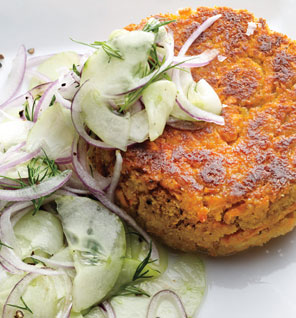
Chickpea and Sweet Potato Cakes

Chickpea and sweet potato cakes

Sarah and I recently took Milly for a bite to eat at the Lido in Racecourse Road. I was absolutely starving so I ordered their tapas plate. (Ever hopeful!) Sarah followed suit and we both ended up with enormous platters of food which we couldn’t possibly hope to finish. The best were the chick pea and sweet potato (kumera) cakes that were absolutely delicious. Needless to say I bought sweet potatoes and chick peas to experiment the next day and while my experiments were cooking I began leafing through the current edition of Australian Gourmet Traveller. There, on page 54 was a recipe for Chickpea and Sweet Potato Cakes with Green Bean and Mint Salad. Coincidences I believe in, but that was just ridiculous!

Mine was nearly right.

800g orange sweet potato (kumera), cut into boiling size chunks
400g canned chickpeas, well drained
35g (¼ cup) plain flour
1½ teaspoons ground cumin
1½ teaspoons ground coriander
½ teaspoon ground cardamom
Salt and freshly ground pepper
Olive or grapeseed oil for frying

Cook the sweet potato in boiling salted water for 10 minutes or until tender. Drain well. Using a potato masher or ricer, mash until smooth. Add the chickpeas, flour and spices and mix together well. Mould dessertspoons of the potato mixture into rounds and place on a tray.

Heat 2 tablespoons oil in a heavy based frying pan over medium heat and cook the cakes (flattening them a little with a spatula) for 3 minutes on either side or until golden. Keep warm until ready to serve.

Serve with natural Greek yoghurt or tzatziki or raita to dip.

Serves 4.

 Photo by: self.com

Christmas Glazed Duck Breasts in Orange Jus

Glazed Duck Breasts in Orange Jus

The duck breasts we have had for Christmas dinner for the last few years require quite a bit of organisation beforehand if Christmas day is to be hassle free. The breasts themselves are not difficult to cook, even if this method, (which I have borrowed from Tetsuya Wakuda) involves moving them from a frying pan to the oven to the griller. It is the sauce (or gravy, or jus) that presents the problem.

The breasts release a good deal of fat (which should be kept), but very little else that will help you to begin making a good sauce. They do release some juices when they are resting and these are, of course added to the sauce. It is a little late to begin, though, when the breasts are about to be served.

If you already have some homemade chicken gravy as a starting point, things become much easier. It really is worthwhile cooking a chicken during the week before Christmas for this express purpose. Have demi-glace on hand, bought or homemade, homemade chicken stock, a bottle of Grand Marnier and a made-up quantity of orange sauce base. The orange sauce base gives the sauce depth. Zested orange peel is an optional extra.

You can also make up the glaze beforehand.

If you have done all this and then find at the last minute that the shop from which you have ordered your duck breasts has itself forgotten to order duck breasts, (which has happened to me two years in a row), you can be forgiven for having a nervy turn! Last year, the only place that could help me at short notice was Black Pearl Caviar, really desperation stuff! The bonus was that the breasts (magrets) were from ducks with the most obscenely large breasts. They were expensive but absolutely delicious.

I think the moral of the story is to buy your breasts a couple of weeks before Christmas. Chances are they will be frozen anyway and they might as well sit in your freezer as in somebody else’s.

6 duck breasts (large if possible)
Salt and freshly ground pepper
1 – 2 tablespoons grapeseed oil
Plain flour
Good chicken gravy, prepared beforehand
Good chicken stock (or duck stock if you have it)
Demi-glace
Orange sauce base (see below)
2 tablespoons Grand Marnier
Zested rind of 1 orange
Glaze (See below)

Orange sauce base:
3 tablespoons brown sugar
3 tablespoons malt vinegar
3 tablespoons orange juice, strained

Caramelise the brown sugar and malt vinegar together in a saucepan, then carefully add the strained orange juice. Simmer, then cool.

Duck glaze:
150ml soy sauce
2 tablespoons brown sugar
50ml mirin

Combine soy sauce, brown sugar and mirin in a saucepan and stir until sugar has dissolved. Set aside.

Line griller tray with foil and preheat oven.

Trim the duck breasts and season with salt and freshly ground black pepper.

Brown breasts, in batches, skin side down, in the grapeseed oil in a non-stick frying pan. When the skin is dark brown and crisp, turn to cook the flesh very briefly. Reserve the fat for another use.

Transfer the breasts to a baking dish and place in the oven to cook for another 5 – 6 minutes depending on the size of the breasts. Remove from oven, place on a warm plate, cover with foil and allow to rest.

Strain off all but a little fat from the baking dish, add a little plain flour if there is sufficient duck juice to warrant it. Add chicken stock and make a light gravy. If insufficient duck juice, omit this step.

Place duck gravy (if any), prepared chicken gravy and orange sauce base in a saucepan with a little chicken stock and bring to the boil. Add Grand Marnier and 1 tablespoon demi-glace, reduce heat and simmer gently. Check seasonings.

Remove duck breasts from foil, carefully pouring any accumulated juices into the sauce.

Place breasts, skin side down, on foil covered grill tray and paint each breast with glaze. Brown lightly. Remove from grill, re-paint with glaze and replace under grill. Repeat one more time, each time being careful to remove the duck before it burns.

Cover breasts again with foil. Check the sauce and add zested orange rind, if using.

Spoon jus onto serving plates and top with duck breasts, skin side up.

Serve with roasted potatoes and red cabbage.

Serves 6.