Sauces

Mango and Chilli Mayonnaise

Crab sandwich with mango and chilli mayonnaise

This one is my own. Unfortunately, as usual, I have never paid much attention to quantities, but the thicker the mayonnaise is to begin with, the more mango and chilli paste it will hold.

If you are sure your guests like coriander, add finely chopped leaves at the end. Otherwise finely chopped mint leaves work equally well. The mayonnaise keeps better without either.

This mayonnaise is perfect with prawns or crabs.

250ml (1 cup) mayonnaise (home made is preferable but Helman’s is the best alternative)
125ml fresh mango puree
1 tablespoon roasted chilli paste (sambal oelek)
1 tablespoon finely chopped coriander or mint leaves, stalks removed (optional)

Combine all ingredients until well blended.

Cocktail Sauce or Cocktail Mayonnaise

Have you ever thought how nice it would be if we had Dad’s beloved seafood cocktail sauce already made up? Well we could, if only Dad liked it in the form of mayonnaise instead of based on cream.

250ml mayonnaise (home made is preferable but Helman’s is the best alternative)
4 tablespoons Heinz tomato sauce
1 teaspoon brandy
A good dash of Lea and Perrins sauce, to taste
Tabasco sauce, to taste
Salt and freshly ground black pepper

Combine all ingredients well.

Fish stock (fish fumet)

Fish and other seafood must be treated differently from meat or chicken when making stock. It cannot be simmered for hours as meat can, or the resulting stock will be bitter, and quite toxic. Fish fumet always contains white wine, but you can make it without and add the wine later, when you are using the stock in a soup or sauce.

For years we have used a scaled and cleaned whole bream or whiting frames as the starting point for fish fumet, but fish frames, particularly reef fish frames are usually available very cheaply from any good fishmonger. I have used red emperor, nanagai, coral trout and even Tasmanian salmon, although the salmon frames give a distinctly salmon taste.

50g butter or a little grapeseed oil
3 sticks celery
1 medium onion, chopped
Sprigs of parsley and thyme
½ bay leaf
½ bottle of dry white wine
Whiting frames and/or scaled and cleaned whole bream, or
1 or 2 white fleshed reef fish frames
Water to cover

In a large stockpot, melt the butter or heat the oil and add the herbs, onions, carrots and celery. Cook over a gentle heat without browning. Add the fish frames and /or the whole bream and allow the frames to saute briefly, turning them to ensure even cooking.

Add the white wine. Cover the pot and increase heat to high. When the wine has reduced to half its previous volume, put in enough cold water to cover the fish. Bring back to the boil, reduce heat, skim and simmer the stock for no more than 30 minutes.

Strain the stock through a coarse sieve, pressing the fish and vegetables with the back of a spoon to release as much flavour as possible. Return fish and vegetables to the pot, add a little boiling water and stir well, but do not cook any further. Strain this into the stock. Discard the frames and the vegetables and re-strain the stock through a fine sieve.

Refrigerate stock so that the fats rise to the surface, then skim. (Fish frames do contain fat.)

Fish stock will keep well in the freezer.

Roasted (brown) chicken stock

I have never had a problem with chicken carcasses being placed straight in the stock pot without prior roasting. However Philip Johnson included a recipe for roasted chicken stock in his e’cco 1 cookbook, giving it as an alternative to traditional chicken stock. Gordon Ramsey, the bad boy of English cooking is unequivocal. White chicken stock, he says, is anaemic and to give it more depth of flavour, the first thing to do is to brown the carcasses. (He actually calls it Brown Chicken Stock.) I am sticking with Philip’s  name, (because a sauce made from browned chicken carcasses will not, technically, be a brown sauce). This recipe is a combination of both of theirs, plus mine. They both include raw garlic in the stock and I believe that raw garlic gives a harsh, unpleasant flavour. If I were using garlic, I would use garlic confit.

2 kg chicken bones and carcasses
1 carrot, diced
1 – 2 onions, roughly chopped
a few cloves of garlic confit (optional)
1 leek, well washed and sliced
2 tablespoons tomato puree
4 sprigs thyme
1 bay leaf
1 teaspoons white peppercorns
a few parsley stems
1 cup of white wine

Preheat the oven to 200C. Place chicken carcasses in a roasting pan and roast until golden. Take care not to colour the chicken too much as this will make the stock bitter.

Using tongs or a slotted spoon, transfer the bones to a large stock pot and add remaining ingredients, except the wine. Cover with cold water and bring to the boil, skimming off any impurities that rise to the surface.

Pour off and discard any fat from roasting pan, then place pan over moderate heat and deglaze by adding the wine and stirring well to loosen the sediment. Pour mixture into stock pot and continue to simmer gently for 1 ½ hours, skimming occasionally.

Strain stock, cool and refrigerate overnight. Next morning, carefully remove any fat from the surface.

Freeze until ready to use.

Chicken stock

Making Chicken Stock

Chicken frames, as many as you can comfortably fit in the stock pot
1 – 2 onions, roughly chopped
1 carrot, chopped
4 – 6 sticks celery roughly chopped
A handful of parsley
Water to cover
Freshly ground black pepper

Place the frames in a large stock pot, add the onion, carrot, celery and parsley and cover with water. Bring to the boil, then reduce heat, then cover and allow to simmer over very low heat for 5 – 6 hours if possible.

Strain, pressing the bones with the back of a spoon, to release all the juices. Transfer to a clean container and allow to cool. Refrigerate as soon as possible, then leave overnight until stock is completely cold and all fat has risen to the surface. De-grease the stock carefully. This is particularly important if you are making a consomme. The stock should be a thick jelly. Reheat just enough to liquefy the stock and pour into airtight containers, some of which should be no bigger than 250ml capacity.

Freeze when cool.

 You will notice that I never add salt to chicken stock. I prefer to season the dish to which the stock is added.

Faux eggs ‘Florentine’

Faux eggs florentine cropped
This is really just another take on the Eggs Benedict theme….poached eggs with hollandaise sauce, sitting on, this time, spinach. True ‘Eggs Florentine’, it is not, despite the fact that many breakfast-serving Brisbane restaurants are calling it that. I guess you can call anything sitting on spinach ‘florentine’! Nevertheless, the egg, spinach and hollandaise combination is quite delicious!

4 thick slices of sourdough bread
Olive oil
1 clove of garlic (optional)
Baby spinach leaves
8 poached eggs (these can be poached in advance and reheated, as they would be in a restaurant situation)
Hollandaise sauce (see Sauces)
Cayenne pepper
Sea salt and freshly ground black pepper
Chives, trimmed, but left long, to garnish

Brush both sides of the sourdough slices with a little olive oil and place under a hot grill for 1 – 2 minutes each side, until crisp and golden. Rub one side of each slice with the garlic clove.

Top each slice of sourdough with a generous quantity of baby spinach, top the spinach with 2 reheated and well-drained poached eggs. Spoon hollandaise sauce over the eggs.

Sprinkle with a little cayenne pepper, then season with sea salt and freshly ground black pepper.

Garnish with the chives and serve immediately.

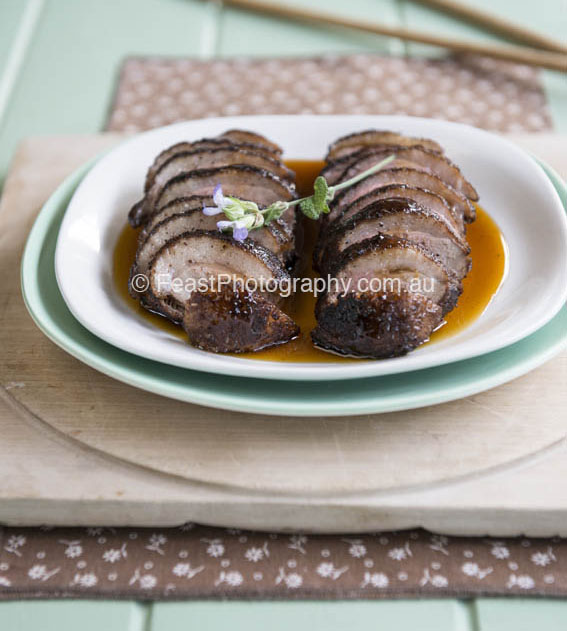
Twice cooked duck breast with blood orange sauce

Twice cooked duck with Blood Orange Sauce

This has become one of my favourite ways of cooking duck breasts. They are tender, succulent and absolutely delicious and the sauce is wonderful too. This recipe also works well with duck legs (thighs and drumsticks).

1 teaspoon Chinese five-spice powder
4 duck breasts or 4 duck legs
500ml canola or grapeseed oil

Blood orange sauce:
Juice of 2 blood oranges (or substitute oranges, mandarins or tangelos)
170g (¾ cup) caster sugar
4 star anise
1 cinnamon stick
1 tablespoon light soy sauce
1 teaspoon Chinese rice vinegar

Bring a wok or large saucepan of water to the boil. Rub the five-spice powder over the duck pieces. Put some baking paper in the bottom of a large bamboo steamer. Prick holes in the paper with a fork or a skewer and arrange the duck on top. Cover with the lid and steam over the boiling water for 15 – 20 minutes. Remove the duck from the steamer, put on a plate and refrigerate, uncovered, for 3 hours or until completely cooled, or preferably overnight.
Strain the juice from the oranges and reserve two thick strips of peel.
Combine the sugar with 185ml water in a large saucepan and bring the mixture to the boil for 5 minutes to reduce, stirring to dissolve the sugar.  Add the orange juice, star anise the cinnamon stick and reserved strips of peel and allow to cook so that the sauce reduces. Remove from the heat and stir in the soy sauce and vinegar.
Heat the oil in a wok over high heat. When the surface of the oil is shimmering, lower the duck into the oil, skin side down. Cook for 2 minutes, then turn the duck and cook for a further 2 minutes. Repeat this, cooking for a further 2 minutes on either side.
Put the duck onto a plate, cover, and rest for 5 minutes.
Cut the breasts into thick slices and arrange on the serving plates. Spoon over the orange sauce and the star anise.
Serve with wilted Asian greens.

Serves4

Before you begin – soy sauce

Soy Sauce. Not so very long ago you could simply buy a bottle of ‘soya sauce’. There were, in fact two other sauces available, produced by Conimex and called ‘bentang ketjap manis’ and ‘bentang ketjap asin’. You did not have to be a genius to work out that ‘manis’ meant ‘sweet’ and ‘asin’ meant ‘salty’. I am not sure that it occurred to any of us that bentang ketjap was simply Indonesian soy sauce and that sweet and salty were two preferred Indonesian varieties. The point I am making is that each country in Asia has its own version of soy sauce made from soy beans. They are not interchangeable. Using bentang ketjap manis in Japanese cooking instead of Japanese shoyu is absolutely unthinkable. Chinese soy sauce is not a convenient catch all for all other Asian countries’ versions of soy sauce, although I found Korean soy very similar to Chinese soy in some cases, and more like Japanese shoyu in others. Not surprising, I suppose when you consider where Korea is situated.

The problem is further complicated by the fact that every Asian country has different kinds of soy sauce. China, Korea, Japan, Thailand and Vietnam all have dark and light soy sauces. Those of Thailand and Vietnam are fairly interchangeable, as are those of China and Korea. I am not sure about Malaysia. Geok uses Chinese soy sauce, but then her parents were Chinese. I suspect that many Malays use a soy sauce similar to that used by the Indonesians, in which case the two main kinds are sweet and salty, rather than light and dark.

As a general rule, use light soy sauce with seafood, poultry and white meats, dark soy sauce when cooking red meat.

Holandaise sauce

Like mayonnaise, Hollandaise and Béarnaise are emulsion sauces. Emulsion sauces are made with egg yolks, oil or fat and an acid to stablilise them. In the case of Hollandaise and Béarnaise, the fat is butter; with Hollandaise, the acid is lemon juice. Adding a teaspoon of the acid to the egg yolks before the fat is added helps prevent curdling and ensures a thick sauce.

Traditionally, all emulsion sauces are made in a double boiler, but both Hollandaise and Béarnaise can be made in a food processor. To finish the sauce you will need a double boiler, or a basin sitting in a saucepan of hot (but not boiling) water.

4 egg yolks
175g butter, melted, but not hot
1 tablespoon water
2 tablespoons lemon juice
Freshly ground black pepper

 Place egg yolks, water and a little of the lemon juice in the bowl of the food processor and, using the metal blade, process until light and well mixed. With the machine switched on, add the butter in a slow steady stream. Continue to process for another 30 seconds. Transfer the mixture to a double boiler, cook at low heat, but be careful not to let the water boil. Add a little cold water to the bottom of the double boiler frequently to keep it below boiling point. Stir the sauce constantly until it thickens to the consistency of custard. Add extra lemon juice to taste, but remember, too much lemon will spoil the sauce. Stir in the lemon juice well to stabilise the sauce. Add freshly ground pepper.

Hollandaise keeps in the refrigerator, but it does harden to the consistency of butter. Remove from the fridge well before serving time to soften it, or stand it in warm water. It may need to be whisked with a fork, or returned to the food processor for a few seconds. Should the sauce curdle, return it to the bowl of the food processor, switch on, and feed 1 – 2 tablespoons of boiling water through the feed tube, a little at a time.

Hollandaise sauce is traditionally served with asparagus or other vegetables, eggs and fish, especially salmon.

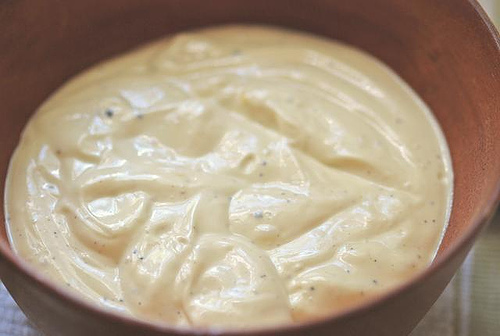
Mayonaise

Everybody should be able to make this simplest of the emulsion sauces without using a food processor, though I realise that, with the time constraints we all have, the food processor method will win every time. Make it by hand just once as it will help you to understand the properties of an egg yolk.

There are a few points to remember whether you are making mayonnaise by hand or with a food processor. If these are kept in mind, the dreaded ‘splitting’ can be avoided.

  • All ingredients should be at room temperature. Warm the bowl in which the mayonnaise is to be made in hot water before beginning and dry it thoroughly. This will take any chill off the egg yolks. Heat the oil to just tepid if it has been refrigerated.
  • The egg yolks must be well beaten for a minute or two before adding anything to them. This will help them absorb the oil better. A little of the acid, that is, the vinegar or lemon juice is then added. This seems to help the oil absorption. The remainder is added at the end.
  • The oil should be added very slowly at first, just drop by drop, until the emulsion process begins and the sauce incorporates into a heavy cream. After this the oil can be added more rapidly.
  • The maximum amount of oil one egg yolk can absorb is about ¾ cup (185ml, approximately). As soon as this volume of oil is exceeded, the mixture will curdle. It is better to measure out the oil for the number of eggs you are using before you begin than risk having to re-incorporate a curdled mess with additional egg yolks.

3 egg yolks
1 tablespoon white wine vinegar or lemon juice
½ teaspoon salt
½ teaspoon prepared Dijon mustard
500ml (2 cups) olive oil or a mixture of olive and other vegetable oil
2 tablespoons boiling water
Vinegar or lemon juice, extra
Dijon mustard, extra
Salt and freshly ground black pepper

Warm the mixing bowl in hot water and dry it thoroughly. Add the egg yolks and, using a wire whisk, beat yolks until they are thick and sticky.

Add the tablespoon vinegar or lemon juice, the salt and half teaspoon of mustard. Whisk for a further 30 seconds.

The eggs are now ready to receive the oil and while it goes in, drop by drop, you must not stop beating until the sauce has thickened. Add the drops of oil with a teaspoon, or rest the lip of the bottle on the edge of the bowl. Keep your eye on the oil rather than on the sauce.

Stop pouring, but continue beating every 10 seconds or so to be sure the yolks are absorbing the oil. After 1/3 – 2/3 cup of oil has been incorporated the sauce should thicken into a very heavy cream.

Once this has happened, the remaining oil may be added 1 tablespoon at a time, whisking well to incorporate between each addition.

If the sauce becomes too thick, thin it out with a few drops of lemon juice or vinegar, then continue adding the oil until all is incorporated.

Beat the boiling water into the mayonnaise. This is insurance against curdling.

Add extra vinegar or lemon juice and mustard to taste.

Season with salt and freshly ground black pepper.