The Basics

Before you begin – Shallots and Green onions

Image

Shallots, spring onions, scallions and now, ‘green onions’.  The word ‘shallot’ in a recipe always presents a dilemma. If the recipe book is written by an Australian, you can be fairly sure that what is meant by a shallot is a long green onion, rather like an overgrown chive. However, in an attempt to resolve an already confused situation, some Australian recipe books have begun referring to these as ‘green onions’.

A true shallot looks very much like a large clove of garlic. Also known here as a French shallot, its skin has a pinkish tinge, whereas garlic has white skin. There are also brown shallots, with brown skin. If you are reading a French recipe book and you have a choice, buy the French shallots. They are available here, but only at the better fruit and vegetable outlets. If you can’t buy French shallots, use small brown pickling onions as a substitute. Some Australian writers, such as Stephanie Alexander, have bitten the bullet and are calling a shallot a shallot.

In America, a shallot is a true French shallot. What we know as ‘shallots’ are called ‘scallions’. I do not know how this confusion arose, but I do wish somebody would fix it. That, of course, would mean re-educating every little fruit and vegie seller in Australia. Perhaps if the big supermarkets began a campaign, something might happen, but if there is no money in it for them, I can’t see it happening.

In this recipe book I have tried to be consistent and use the term ‘green onion’.

How to poach meat or fish

Poaching is a cooking technique that is usually neglected in most cookery books. When meat is thrown into simmering water it inevitably emerges tough and unsatisfying. Think of uncooked chicken in a simmering laksa stock. The toughness is produced because, when the water is at simmering temperature (not to mention boiling), the proteins in the meat begin to harden and disintegrate and the meat becomes dry and tough.

Poaching is generally confined to fish and white meats such as chicken and veal. Lately, though, I have been applying poaching techniques to other ‘boiled’ meats such as ox tongue and silverside and the results have been quite sensational. So much so that Dad’s fishing mates have been asking for recipes. A compliment, indeed.

You will find various references to poaching throughout the book. There is a recipe for Poached Chicken Breasts in this section and “Buffets and Cold Lunches”. Vitello Tonato is a delicious veal and anchovy dish served with tuna mayonnaise (also in “Buffets and Cold Lunches”), is a classic poached dish, as is Poached Whole Fish in the same section. 

Poaching is the slow cooking of meat or fish in water or a court boullion (water enhanced with herbs, spices and vegetables). Poached meat tends to lack colour, but is tender, moist (if properly done) and full of flavour. It has the advantage of being low fat and also of producing some wonderful stocks that can be re-used for poaching, added to soups or used as a base for risotto.

A heat diffusing mat is essential for successful poaching. I find that even the lowest heat on the smallest gas ring will eventually bring a stockpot full of liquid to simmering point without one. A drop lid is also useful. A drop lid is a wooden lid slightly smaller then the diameter of your stockpot that sits on top of the meat and keeps it fully submerged during cooking, allowing all the meat to be cooked evenly. I discovered drop lids when doing my Japanese cooking course. Mine is simply a round wooden breadboard with a knob attached to the centre for lifting it in and out. It should always be soaked in water before using. 

The method of poaching small items such as chicken breasts and fish fillets is slightly different from the method of poaching large ones, though in both cases the cooking is done at poaching temperature. Poaching temperature is a point, well below boiling point, when the surface of the liquid shivers, but no bubbles appear. In a clear liquid you will be able to see a few tiny bubbles on the bottom of the pot, but they will not rise. Never let the liquid simmer, let alone boil.

To poach small pieces of meat or fish fillets, bring the court bouillon (water, stock or other liquid with flavourings added) to simmering point. There should be enough liquid to just cover the meat or fish to be poached. Place meat in the simmering liquid; the temperature will immediately drop to poaching temperature. Watch carefully that the liquid does not return to a simmer and continue to cook until the meat is tender. Remove the pan from the heat when cooked. If the meat is to be served cold, it should be allowed to cool in the poaching liquid. If it is to be served hot, it should be left in the poaching liquid to rest before serving.

Some of the larger cuts of meat will form a scum on top of the liquid when the liquid boils. For this reason, the meat is placed in cold water without any aromatics and brought to the boil to release any scum. The water is then tipped out and the meat is ready to poach as follows.

To poach larger items, such as the veal in Vitello Tonata, whole fish, corned silverside and ox tongue, the meat is placed in enough cold court bouillon to just cover it and is then slowly brought to poaching temperature. This enables the heat to slowly penetrate to the inside of the meat without overcooking the outside. The temperature is kept at poaching point for the entire cooking period. Again, whether the meat is left to cool completely in the poaching liquid generally depends on whether it is to be eaten hot or cold.

Pate brisee

For years this has been the recipe I reach for whenever a savoury pastry shell is called for. 

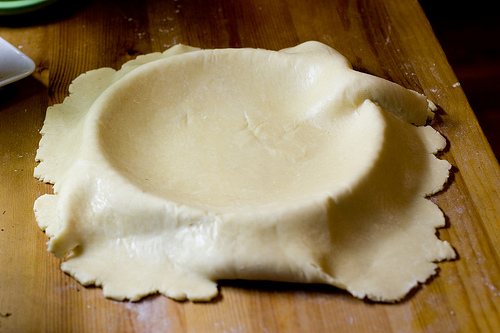
Pate brisee (broken pastry) gives a slightly flaky crust without a strong individual taste, which makes it perfect for savoury flans, pies and quiches.  

These quantities make enough for one 25cm diameter quiche, or 20 tartlet moulds, each 5 cm in diameter and 1cm deep

100g chilled butter
225g plain flour
1 egg yolk
3 tablespoons cold water
1 tablespoon oil
Pinch of salt

Cut the chilled butter into small pieces and put the butter into a mixing bowl with the flour and the salt. Using a fork, or two knives, work the butter into the flour until the mixture has the texture of oatmeal.

Beat the egg yolk with the cold water and add the oil. Make a well in the centre of the flour and butter mixture and pour in the oil. Mix with a fork, then use your hands to form the dough into a ball.

If using a food processor, place the flour and salt into the bowl and add butter cut into small pieces. Using the metal blade, process until the mixture has the texture of oatmeal.

Beat egg yolk with the cold water, and add the oil. With the processor switched on, add the egg mixture through the feed tube, processing until the mixture forms a ball around the blade. Switch off immediately.

Wrap the pastry in waxed paper and refrigerate until firm…at least 20 minutes. This mixture will keep for weeks in the freezer.

If recipe specifies that a pastry shell be ‘blind baked’ before filling, follow the instructions in ‘Blind Baking a Pastry Tart Shell’ in this section.

Holandaise sauce

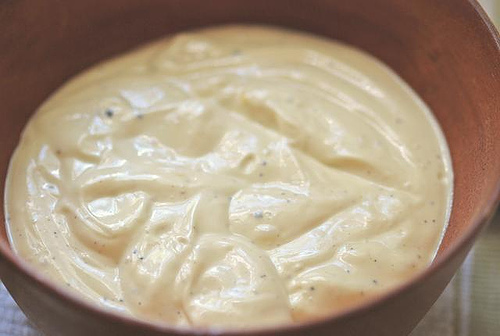
Like mayonnaise, Hollandaise and Béarnaise are emulsion sauces. Emulsion sauces are made with egg yolks, oil or fat and an acid to stablilise them. In the case of Hollandaise and Béarnaise, the fat is butter; with Hollandaise, the acid is lemon juice. Adding a teaspoon of the acid to the egg yolks before the fat is added helps prevent curdling and ensures a thick sauce.

Traditionally, all emulsion sauces are made in a double boiler, but both Hollandaise and Béarnaise can be made in a food processor. To finish the sauce you will need a double boiler, or a basin sitting in a saucepan of hot (but not boiling) water.

4 egg yolks
175g butter, melted, but not hot
1 tablespoon water
2 tablespoons lemon juice
Freshly ground black pepper

 Place egg yolks, water and a little of the lemon juice in the bowl of the food processor and, using the metal blade, process until light and well mixed. With the machine switched on, add the butter in a slow steady stream. Continue to process for another 30 seconds. Transfer the mixture to a double boiler, cook at low heat, but be careful not to let the water boil. Add a little cold water to the bottom of the double boiler frequently to keep it below boiling point. Stir the sauce constantly until it thickens to the consistency of custard. Add extra lemon juice to taste, but remember, too much lemon will spoil the sauce. Stir in the lemon juice well to stabilise the sauce. Add freshly ground pepper.

Hollandaise keeps in the refrigerator, but it does harden to the consistency of butter. Remove from the fridge well before serving time to soften it, or stand it in warm water. It may need to be whisked with a fork, or returned to the food processor for a few seconds. Should the sauce curdle, return it to the bowl of the food processor, switch on, and feed 1 – 2 tablespoons of boiling water through the feed tube, a little at a time.

Hollandaise sauce is traditionally served with asparagus or other vegetables, eggs and fish, especially salmon.

Mayonaise

Everybody should be able to make this simplest of the emulsion sauces without using a food processor, though I realise that, with the time constraints we all have, the food processor method will win every time. Make it by hand just once as it will help you to understand the properties of an egg yolk.

There are a few points to remember whether you are making mayonnaise by hand or with a food processor. If these are kept in mind, the dreaded ‘splitting’ can be avoided.

  • All ingredients should be at room temperature. Warm the bowl in which the mayonnaise is to be made in hot water before beginning and dry it thoroughly. This will take any chill off the egg yolks. Heat the oil to just tepid if it has been refrigerated.
  • The egg yolks must be well beaten for a minute or two before adding anything to them. This will help them absorb the oil better. A little of the acid, that is, the vinegar or lemon juice is then added. This seems to help the oil absorption. The remainder is added at the end.
  • The oil should be added very slowly at first, just drop by drop, until the emulsion process begins and the sauce incorporates into a heavy cream. After this the oil can be added more rapidly.
  • The maximum amount of oil one egg yolk can absorb is about ¾ cup (185ml, approximately). As soon as this volume of oil is exceeded, the mixture will curdle. It is better to measure out the oil for the number of eggs you are using before you begin than risk having to re-incorporate a curdled mess with additional egg yolks.

3 egg yolks
1 tablespoon white wine vinegar or lemon juice
½ teaspoon salt
½ teaspoon prepared Dijon mustard
500ml (2 cups) olive oil or a mixture of olive and other vegetable oil
2 tablespoons boiling water
Vinegar or lemon juice, extra
Dijon mustard, extra
Salt and freshly ground black pepper

Warm the mixing bowl in hot water and dry it thoroughly. Add the egg yolks and, using a wire whisk, beat yolks until they are thick and sticky.

Add the tablespoon vinegar or lemon juice, the salt and half teaspoon of mustard. Whisk for a further 30 seconds.

The eggs are now ready to receive the oil and while it goes in, drop by drop, you must not stop beating until the sauce has thickened. Add the drops of oil with a teaspoon, or rest the lip of the bottle on the edge of the bowl. Keep your eye on the oil rather than on the sauce.

Stop pouring, but continue beating every 10 seconds or so to be sure the yolks are absorbing the oil. After 1/3 – 2/3 cup of oil has been incorporated the sauce should thicken into a very heavy cream.

Once this has happened, the remaining oil may be added 1 tablespoon at a time, whisking well to incorporate between each addition.

If the sauce becomes too thick, thin it out with a few drops of lemon juice or vinegar, then continue adding the oil until all is incorporated.

Beat the boiling water into the mayonnaise. This is insurance against curdling.

Add extra vinegar or lemon juice and mustard to taste.

Season with salt and freshly ground black pepper.


Before you begin: Pastry – a what’s what

I was sitting down having a cup of coffee and discussing recipes with Elly Hartland recently, when she asked me if I had made Philip Johnson’s goat’s cheese and leek pie. I asked her what was so special about it. “The pastry,” she said, “is so different. It isn’t a shortcrust pastry. It is an olive oil pastry. It’s flaky.”

“Pate brisee,” I thought, my heart dropping to my shoes, “uses olive oil.” I use it all the time and have always called it shortcrust pastry. But of course, it isn’t really shortcrust pastry at all! All those recipes are wrong!

Well, as it turned out, the goat’s cheese pie pastry isn’t even pate brisee; it is made entirely with olive oil and I don’t care for it much at all. But I was left with the fact that pate brisee is not shortcrust pastry.

Way back when you were all in kindergarten or pre-school, Simone Beck came to Brisbane for a series of cooking demonstrations and to promote her book ‘Simca’s Cuisine’. Simone Beck is best known, not for ‘Simca’s Cuisine’, but for co-authoring that two volume bible ‘Mastering the Art of French Cooking’. We were all very aware of her legendary importance in the world of haute cuisine and were suitably riveted. She made mushroom tartlets (Quichettes aux champignons).  They were delicious and became my stand-by recipe for many years, as you can see if you look at the state of p232 of ‘Simca’s Cuisine’. Pate brisee “A”, she grandly informed us, and Pate brisee “B”, are to be used for ALL savoury dishes. Obediently, I complied. Pate brisee “A” was fine by me; I have never tried “B”, which substitutes white wine for the water and a whole egg for the egg yolk. Perhaps I should.  She says the wine creates an interesting saveur.

Naturally, I then abandoned Nanya’s sweet shortcrust pastry for Simone Beck’s Pate sucree.

The funny thing about that day is that I swear Elly was with me. Obviously I was more impressed than she was!

Well, I have altered all those recipes, or I think I have.  Fortunately dessert tarts weren’t affected. Where, in savoury tarts, pies or quiches it once said ‘Shortcrust pastry’, it now should read ‘Pate brisee, shortcrust pastry or sour cream pastry’. I apologise.

Elly still doesn’t know that she ruined my day.

Chicken stock

Bought chicken stock in Australia has improved dramatically over the years and now Campbell’s and a few others are good to substitute. But the reality is, you really can’t beat homemade stocks and they are very easy – as long as you’ve got the space in your freezer to keep it, which is a constant problem for us.

Chicken frames, as many as you can comfortably fit in the stock pot
1 – 2 onions, roughly chopped
1 carrot, chopped
4 – 6 sticks celery roughly chopped
A handful of parsley
Water to cover
Freshly ground black pepper

Place the frames in a large stock pot, add the onion, carrot, celery and parsley and cover with water. Bring to the boil, then reduce heat, then cover and allow to simmer over very low heat for 5 – 6 hours if possible.

Strain, pressing the bones with the back of a spoon, to release all the juices. Transfer to a clean container and allow to cool. Refrigerate as soon as possible, then leave overnight until stock is completely cold and all fat has risen to the surface. De-grease the stock carefully. This is particularly important if you are making a consomme. The stock should be a thick jelly. Reheat just enough to liquefy the stock and pour into airtight containers, some of which should be no bigger than 250ml capacity.

Freeze when cool.

You will notice that I never add salt to chicken stock. I prefer to season the dish to which the stock is added.

Before you begin: Flour facts

That flours ain’t flours has been forcibly brought home to me recently and in my endeavours to find out more, I have discovered that the mere housewife who does not want to buy her flour in 20kg bags is very poorly catered for, particularly in Queensland.
IMG_2678Flour is the ground meal from wheat and other grains including rye, barley, oats, corn and rice.  All have been used to make bread for thousands of years and until the latter part of the 19th century, all grains were milled between heavy millstones, which ground the whole grain. These days, flour, especially wheat flour, is milled using high-speed metal rollers. These rollers extract the outer husk (bran) of the wheat and the germ (the plant’s embryo), leaving just the central part of the seed, the endosperm. The bran and the germ can be returned to the flour to give wholemeal flour.

White flour is made from the endosperm only and it is this endosperm that contains all the gluten-forming proteins. Flours with different gluten levels are made from different varieties of wheat. Strong plain flour is milled from so-called ‘hard’ wheat varieties with a high gluten level. ‘Soft’ wheat varieties have a low gluten level and the flour milled from them is far more ‘tender’ than that milled from ‘hard’ wheat.

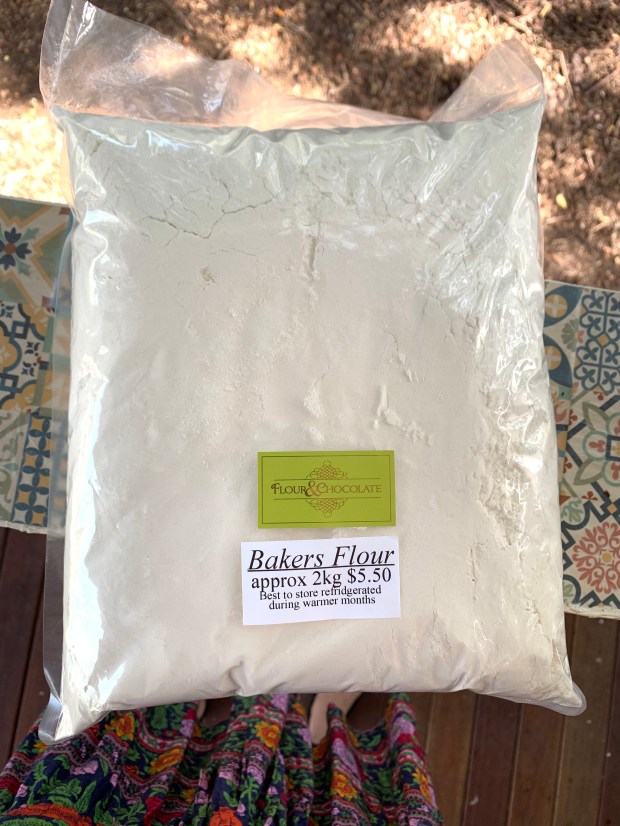
Strong flour is sometimes referred to as baker’s flour or bread flour, although this is not strictly true, as there are stronger flours than that needed to make bread. However, the extra protein is particularly important in bread making. The kneading of the dough develops the gluten network necessary to trap the gas given off by the yeast. The trapped carbon dioxide stretches the gluten fibres further and the dough rises. This gluten web sets during cooking and a firm well-aerated bread is produced. If there is insufficient gluten in the flour, the gluten network cannot be established and the rising does not take place. The extra protein in strong flour also helps the flour absorb more fat and liquid without the mixture ‘splitting’. Strong flour can contain as much as 15% gluten, whereas baker’s flour usually contains around 11 – 12%.

In America soft flour is widely sold as ‘cake flour’. In Australia we are not so lucky. Self-raising flour is (supposedly) soft flour with baking powder (a chemical leaven) added. The baking powder takes the place of the gluten, giving self-raising flour the tender properties of soft flour with the rising properties of strong flour. However there is so little difference between the gluten levels in plain and self-raising flour in Australia there is no point at all in buying self-raising flour.

Plain white flour is sometimes known as ‘all purpose flour’. It is a mixture of hard and soft flours, the proportions in which they are mixed determining the gluten level of the flour. This varies quite significantly from brand to brand. It is a ‘compromise’ flour, being neither really suitable for bread making with too low a gluten level, nor for good cake making with too high a gluten level.

Wholemeal flour, despite common belief, is neither ‘less refined’ nor ‘less processed’ than plain flour. It is processed to white flour and in most cases, the bran only (not the germ) is mixed back into the flour. Similarly, ‘stone ground’ flour (which, I am assured by one of Defiance’s ex-millers, is not, and never has been stone ground) is processed to plain flour and some bran is added. Such flours have more dietary fibre than white flour and are less white in appearance. They are better for you, but ‘less processed’ they are not. Because of the presence of the bran, the gluten content (in grams per 100grams of flour) of such bread is lowered. Breads made with such flours will naturally be heavier.

The most common misconception regarding flour is that most flour is bleached. Bleaching is a process in which a chlorine gas is passed through the flour at some stage of the milling process to whiten it. Most, if not all flour sold in Australia is unbleached. One home economist from Allied Defiance even went so far as to tell me it was illegal to bleach flour and has been for thirty years. Some mills do still bleach flour but it appears that they do this largely for export to Asia where snow-white flour is considered superior.

No flour mill in Australia produces bleached flour for the domestic supermarket market, so if you are buying flour from the local shop you can be confident it is unbleached.  White flour actually whitens naturally with age.

So can you get away with just one ‘all purpose’ flour in your pantry? Well, in theory, yes, provided you have the necessary additives. If you are making bread or pizzas you will need gluten flour to increase the gluten content of plain flour (of which more later). If you want to make cakes or scones, you can convert plain flour to self-raising flour by adding baking powder. In fact, if the baking powder is added just before baking it is more effective and the cream of tartar is less likely to leave a bitter taste in the flour as it can, especially if the flour is old.

Can you get away with just baker’s flour in your pantry? Again, in theory, yes. Maggie Beer seems to manage it brilliantly, though I am told that unless she has an extremely deft touch with her blender, her cakes may be just a tiny bit heavier than necessary, and even a little chewy.

Alternatively, you can convert plain flour to baker’s flour by adding 3 teaspoons of gluten flour to every 500g of plain flour. (Or 1 teaspoon of gluten flour to 1 cup of plain flour.) Note that gluten flour is NOT baker’s flour. It is gluten extracted from the flour during the milling process. It has a protein content of 69.5g per 100g of flour. (Compare this with 12g per 100g flour for Defiance brand baker’s flour.) Gluten flour is sometimes available in the health food section of supermarkets and usually from health food shops.

If you wish to convert baker’s flour to plain flour, you simply use less. For every cup of plain flour you wish to use, fill a cup with baker’s flour and then remove 1 tablespoon. Proceed as if you were using plain flour.

To convert plain flour to self-raising flour, add 4 level teaspoons (a teaspoon measure is more accurate than a teaspoon) to every 250g of plain flour and sift together twice to ensure they are blended.

As for me…   Well, I suppose I will continue to buy 5kg bags of baker’s flour just for making pizzas and souffles. Who knows, perhaps one day I will make bread? I will continue to have a jar of gluten flour in the cupboard just in case my baker’s flour has too many moths in it to be usable. I will continue to buy Defiance brand plain flour out of some misplaced loyalty to Defiance flour which now belongs to a multinational company and because it has a nice middle-of-the-road gluten content of 10.8%.

I will not be buying self-raising flour, but will now add baking powder to plain flour when I want to make a cake or bake scones. I may even buy some White Wings brand plain flour because it has a gluten content of only 9.6% and therefore should be better for cakes than Defiance plain flour.

Oh! I nearly forgot the wholemeal flour which I use for some biscuits, the oatmeal and the fine oatmeal, the ground rice and rice flour, the Italian ground rice and the cornflour for Chinese cooking and of course the Fielder’s wheaten cornflour for other things. Perhaps I should get some rye flour?

………

It is now late 2008, and I am very pleased to say that a new flour brand has recently appeared on the shelves of some of our bigger supermarkets. This is Anchor brand “Lighthouse” special purpose flour. There are two plain flours: Cake, Biscuit and Pastry flour with a gluten content of 8.5g per 100g, and Bread and Pizza flour with a gluten content of 11.0g per 100g. Whilst the latter is not quite as strong as Defiance’s baker’s flour at 12.0g per 100g, it does come in 1kg packs, not 5kg ones like Defiance’s. (Even stored in plastic tubs, my baker’s flour always ended up full of moths before I could get even half way through it.)  However, I have already made twice-cooked gruyere cheese soufflés with the Anchor Bread and Pizza flour, and they were wonderful and didn’t even threaten to split!

Even better still, Anchor brand “Lighthouse” self raising flour has a gluten content of 8.2g per 100g making it a true “cake’ flour. (Compare this with both Defiance and White Wings self raising flours at 9.5g per 100g.) Needless to say, I am changing my allegiance from Defiance to Anchor, (and go back to using self raising flour), even if it means that I have to go to Coles or Woolworths to get them!

But, do I use soft or strong plain flour for gravy, for fish and other batters, or do I continue to buy a middle of the road plain flour for just these everyday eventualities? Oh dear!

Soft poached eggs

IMG_0430

“Good poached eggs are one of the joys of this life, but a properly poached egg is a rare thing. Even after thirty-something years of marriage, I cannot get used to eggs poached in an egg poacher. Nanya poached eggs to perfection, and the only other person I have known since to do this, was Peter Maloney. Not to mention the fact that eggs cooked this way do not leave that impossible-to-get-off albumen deposit on the egg poacher.”

I wrote the above about six years ago, and despite thinking I had the art of egg poaching down to a fine art, I still didn’t really. I have bought egg timers, experimented with eggs poached in cling wrap (!) and usually resorted to the good old egg poacher.

Yesterday, however, Dad returned from a trip to the Whitsundays fishing on South Pacific 11 with Ron Jenyns, Bobby Douglas and numerous other reprobates. Ron’s resident chef, Brett, served perfect soft poached eggs to at least twelve people for breakfast every morning. When everybody except Bobby and Dad went collecting those horrible black-lip oysters that grow in the Whitsundays, they cornered Brett and asked him to teach them to poach the perfect egg. This morning I was presented with two on toast. And they were perfect.   

Brett’s theory is that it is the vinegar that is added to the poaching water that sets the albumen (the white).  The problem with most people is that they simply don’t add enough vinegar so the white floats around in a most unappetizing fashion. He uses 1 part vinegar to 15 parts water. If you think that is a lot, he says that most restaurants use 1 part vinegar to 7 parts water. Use the cheapest vinegar you can buy. The one he uses in the one I use for cleaning windows.

Heat a large saucepan (forget the frying pan – you should have at least 10 cm of water to poach the eggs in. Work out just how much water you have used and do your sums. You’ll soon get used to using the right amount of vinegar.

Bring the water/vinegar to the boil. Break the eggs straight into the water (none of this ‘break it into a cup and slide it into the water first’!) The eggs will sink like stones so slide a spoon under each egg to ensure it doesn’t stick to the bottom. Then turn down the heat until the water is barely moving.

Once the eggs are in and not sticking, increase the heat to a gentle simmer. When they rise to the surface of the water, they are done and should be removed immediately to drain.

Note:  Eggs can be poached up to 24 hours in advance. Slip eggs into a bowl of iced water to cool quickly and not cook further.  Cover the bowl and store in the refrigerator. Reheat eggs by carefully lifting them from the water and sliding them into a pot of gently simmering water. Allow 1 minute to heat through, remove and drain well on absorbent paper.