Boeuf Bourguignonne (Beef Burgundy)

BEEF BOURGUIGNONNE

Beef Burgundy is one of the French classic casseroles; it is the beef equivalent of Coq au Vin. You will notice that neither dish contains the tomatoes that are so characteristic of the dishes of the Mediterranean coast. Use rump steak for this for best results.

1.5kg rump steak or oyster blade
Light olive oil for cooking
250g kaiserfleisch, or fatty bacon
2 tablespoons brandy
1 – 2 tablespoons plain flour
450ml red wine
300ml beef stock
4 French shallots, or a further 4 pickling onions, finely chopped
2 cloves garlic, finely chopped
3 teaspoons tomato paste
1 bouquet garni
Salt and freshly ground black pepper
12 – 14 tiny pickling onions
30g butter
150g button champignons or button mushrooms (buy the tiniest ones possible)

Cut the beef into 3cm cubes and the kaiserfleisch or bacon into bite size pieces. Heat oil in a heavy based frypan and heat a little of the olive oil until very hot. Sauté the kaiserfleisch or bacon until crisp, remove it to a plate and set aside. The bacon is not added to the casserole until near the end of cooking.

Add the meat in small batches to the oil and bacon fat in the frying pan and seal the meat on all sides until well browned. The colour achieved now will affect the final outcome of the casserole. When all the meat has been sealed, return it all to the pan and add the flour, mixing well with the meat to incorporate.

Gently heat the brandy in a small saucepan and making sure the exhaust fan is turned off, set the brandy alight. Pour the brandy over the meat and toss it through until the flame subsides. Place the meat in a heavy casserole.

Pour the stock into the pan with the red wine and de-glaze the frying pan, scraping any bits from the sides and bottom and stirring them well into the liquid. Add to casserole.
Heat a little more oil and gently sauté the garlic and shallots until tender. Some recipes add them to the casserole raw, but I prefer to cook them. Add to casserole, then add the tomato paste, the bouquet garni and season to taste. Make sure there is enough liquid in the casserole to cover the meat. If not, add more water or stock. Cover the casserole and place it in a preheated oven at 220C for 10 minutes, or as long as it takes for the mixture to come to the boil, then reduce temperature to 150 – 180C and allow to cook for about 1½ hours. Remove from oven and allow to cool.

Refrigerate overnight. Next day, remove all fat from the surface of the casserole.

Gently re-heat casserole on top of stove and add the bacon.

While casserole is re-heating, sauté the peeled whole pickling onions in the half the butter until they are beginning to colour and all are well glazed. Add to casserole. Trim the mushrooms and cut any that are too big in half, otherwise leave whole. Add the remainder of the butter to the pan and sauté the mushrooms for just a minute. Add the mushrooms only 10 minutes before serving time. Check the seasonings and serve garnished with chopped parsley.

You will note that I cook half this dish in the oven and finish it on top of the stove. I still believe that the French slow-simmered dishes are better cooked with heat surrounding them than sitting directly on the heat where the bottom is likely to catch and spoil the flavour.
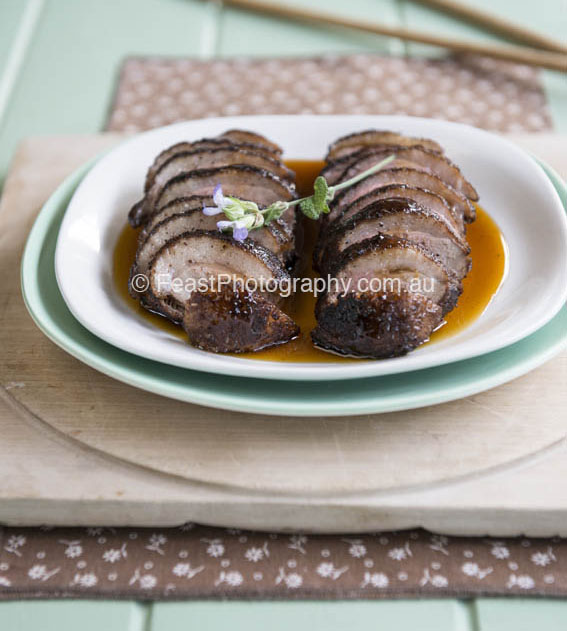
Twice cooked duck breast with blood orange sauce

Twice cooked duck with Blood Orange Sauce

This has become one of my favourite ways of cooking duck breasts. They are tender, succulent and absolutely delicious and the sauce is wonderful too. This recipe also works well with duck legs (thighs and drumsticks).

1 teaspoon Chinese five-spice powder
4 duck breasts or 4 duck legs
500ml canola or grapeseed oil

Blood orange sauce:
Juice of 2 blood oranges (or substitute oranges, mandarins or tangelos)
170g (¾ cup) caster sugar
4 star anise
1 cinnamon stick
1 tablespoon light soy sauce
1 teaspoon Chinese rice vinegar

Bring a wok or large saucepan of water to the boil. Rub the five-spice powder over the duck pieces. Put some baking paper in the bottom of a large bamboo steamer. Prick holes in the paper with a fork or a skewer and arrange the duck on top. Cover with the lid and steam over the boiling water for 15 – 20 minutes. Remove the duck from the steamer, put on a plate and refrigerate, uncovered, for 3 hours or until completely cooled, or preferably overnight.
Strain the juice from the oranges and reserve two thick strips of peel.
Combine the sugar with 185ml water in a large saucepan and bring the mixture to the boil for 5 minutes to reduce, stirring to dissolve the sugar.  Add the orange juice, star anise the cinnamon stick and reserved strips of peel and allow to cook so that the sauce reduces. Remove from the heat and stir in the soy sauce and vinegar.
Heat the oil in a wok over high heat. When the surface of the oil is shimmering, lower the duck into the oil, skin side down. Cook for 2 minutes, then turn the duck and cook for a further 2 minutes. Repeat this, cooking for a further 2 minutes on either side.
Put the duck onto a plate, cover, and rest for 5 minutes.
Cut the breasts into thick slices and arrange on the serving plates. Spoon over the orange sauce and the star anise.
Serve with wilted Asian greens.

Serves4

Red cabbage with bacon and hazelnuts

 Red cabbage with hazelnuts and bacon

Red cabbage seems to work wonderfully with duck. We have used this recipe (sometimes with slices of peeled granny smith apple through the cabbage) with duck breasts for Christmas dinner. It is ridiculously easy but adds wonderful colour to any plate!

Olive oil
1 large onion, sliced
2 cloves garlic, crushed
½ red cabbage, shredded
125ml best red wine vinegar
½ cup brown sugar
½ cup parsley, preferably flat leaf
10 rashers finely sliced bacon, grilled until crisp*
½ cup hazelnuts, roasted and skinned

Roast and skin the hazelnuts.

Heat a heavy-based saucepan over medium heat and add a little olive oil. Add onion and garlic and sweat until onion is transparent. Add cabbage to pan and sauté until softened.

Add vinegar and brown sugar, mix lightly, cover and cook for 10 minutes. Remove lid and cook for a further 5 minutes.

Just before serving, fold in parsley, then top with crisp bacon and scatter with hazelnuts.

*To crisp the bacon, place in a single layer under the griller and grill until crisp. Drain on absorbent paper.

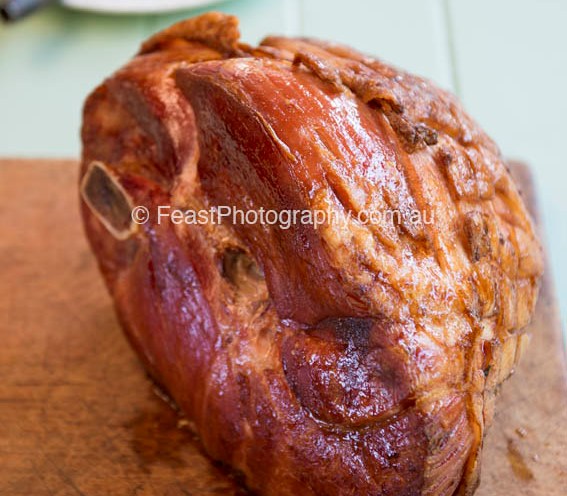
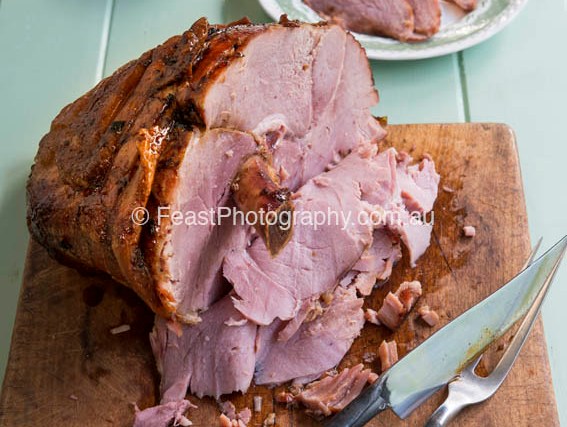
Baked Ham with Guinness and Cardamon Glaze

Baked Ham with Cardamon and Guinness Glaze

Dad doesn’t really like baked ham; we have a leg of ham so rarely that he feels that it is unnecessary. But every time we’ve served this it has been a huge success. It is probably the most succulent way to cook a ham.

Smoked or cooked leg ham, usually about 10-12 kg.
1½ cups Guinness stout
1 cup brown sugar
1 teaspoon dry mustard
1 teaspoon ground ginger
1 teaspoon ground cardamom
2 tablespoons stout extra

Garnish:
Thin pineapple slices
Parsley, finely chopped

Firstly, remove the skin from the ham. This can be done the night before, in which case the ham should be re-covered with the skin, then wrapped in aluminium foil and refrigerated overnight.

To remove the skin, preheat the oven to 160C and heat the ham, in a large baking dish, for ½ hour. Remove from oven and carefully peel the skin from the ham, using a small knife to help you. Try not to tear the fat. Score the fat in a diamond pattern; cut the skin off the bone and wrap the bone in aluminium foil.

Preheat the oven to 160C.

Pour 1½ cups of Guinness over the ham and bake for1 ½ – 2 hours depending on the size of the ham. Remove from oven and score the fat, cutting in even diagonal lines both ways, so that you create even diamond shapes over the surface. Baste with pan juices.

Increase oven heat to 200C.

Mix together the sugar and spices and add just enough stout to form a thick paste. Spread the paste over the ham and bake in hot oven for a further 30 minutes.

Remove from oven and decorate with chopped parsley. Arrange pineapple rings on platter with the ham if desired.

Baked Ham with Guiness and cardamon glaze

Almond milk and asparagus soup with truffle oil

This is not one of mum’s recipes but my own after my visit to The Sand End pub in Kate’s street in London. Saturday night was my first attempt and other than not being able to get the flower petals to garnish, it looked and tasted fantastic!

I made the almond milk from scratch as opinion seems to be that packaged almond milk has too much water added. I used raw almonds and it was very time consuming as you need to blanch the almonds and remove the skin. When I do it again, I’ll just buy blanched almonds although they do come at a premium price.

500g of blanched almonds
Hot water
3 bunches of asparagus
Lemon juice of one small lemon
Lemon zest
Chicken (or vegetable stock)
Truffle oil
Edible flowers (if available)

Pour boiling water over almonds and allow them to soften for 2 hours. Strain and add half the almonds to blender (500 grams is too much for most blenders). While blending the almonds slowly pour hot water into the blender – but do not add too much too quickly; you want a soup-like consistency. Repeat for the second half of the almonds.

Using a muslin cloth, strain the blended almonds and water mixture into a bowl. I hung mine up and let it drip, but still ended up squeezing the milk out by hand. The resulting liquid should be the consistency of milk but “grainier”.

Steam the asparagus to a firm but edible consistency – do not overcook. Drain and then place approximately two bunches of asparagus into the blender until it becomes a paste. The remaining asparagus is for garnish. Add the almond milk back into the blender and continue to blend. The resulting liquid should be still quite runny.

Pour the soup into a saucepan and add approximately 1 cup of stock, one piece of lemon peel and the juice of one lemon over a watched gentle flame. Heat the soup, continually stirring so that it does not stick to the base. As you do this the soup will thicken. You want the soup to become very thick so that you can thin it by adding more stock (but without adding so much that the subtle almond and asparagus tastes are over-powered).

Before serving, cut the remaining asparagus spears in half and add 2 spears to a shallow soup bowl. Remove the lemon skin and ladle the soup over the asparagus.

To serve, garnish with a drizzle of truffle oil and a pinch of lemon zest. If you happen to be able to find edible flower petals then this looks great.

Serves 4.

Risotto Milanese

Risotto Milanese is the traditional accompaniment to Osso Buco. In its genuine form, it contains beef bone marrow, though this is usually left  out of most modern versions of the risotto. Because I love beef bone marrow, I am putting it in.

375g arborio rice
60g butter
75g uncooked beef bone marrow, chopped
1 large onion, finely chopped
750ml chicken stock
250ml dry white wine
½  teaspoon saffron threads
30g butter extra
2 tablespoons Parmesan cheese, grated
Salt and freshly ground pepper

In one saucepan, bring stock to the boil, then reduce to a simmer.

In another large heavy-based pot or casserole, heat oil and cook onion until tender. Stir in the bone marrow, then add the rice and stir well until all the rice has been coated with the butter. Add wine and 1 cup of the hot stock and the saffron. Bring to the boil, stirring well. When liquid has almost evaporated, add more stock, stir until liquid has almost evaporated and continue to add stock and stir until the risotto is ‘al dente’, or cooked but still firm. Cooking is all done with the pot uncovered and should take about 20 minutes. The risotto should not be too dry.

When almost cooked, add extra butter and grated Parmesan and stir until melted. Serve at once.

Serves 6.

Osso Buco

Osso Buco is a specialty of Milan where it is traditionally served with a risotto made with onions, wine and Parmesan cheese coloured with saffron. I will try to remember to include the recipe. Failing the risotto, simply serve with fluffy white rice.

The Milanese have a special cooking pot for osso buco. It is a very wide, shallow cast iron casserole with a lid, and it allows the veal shanks to be cooked in one layer so that the meat does not fall off them. You can actually tie the meat onto the bone, remembering to cut the string off before presenting them!

Ask the butcher to prepare the veal shanks for you. The veal classified as osso buco sold in a lot of shops is way too thin. The shanks should be about 6cm long and each should weigh about 750g.

6 veal shanks, each 750g in weight
3 – 4 large onions, finely chopped
2 cloves garlic, crushed
3 carrots, finely chopped
4 sticks celery finely chopped
Plain flour
3 x 400g cans Italian tomatoes or 1 bottle Italian tomato sauce
Oil for cooking
1 cup dry red wine
1can Campbell’s beef consommé
1 teaspoon dried basil
1 teaspoon dried thyme
1-2 bay leaves
1 strip lemon peel
Salt and freshly ground pepper

Zested lemon peel to garnish, a good teaspoon full for each person.
Parsley, finely chopped to garnish

Tie the veal shanks firmly with string. Heat oil in a heavy based frying pan and fry the shanks until they are well browned on all sides. Carefully stand the shanks upright in a heavy casserole so that the marrow does not fall out of the bones. Sprinkle well with seasoned flour, moving the shanks gently so that the fat on the meat absorbs the flour. Deglaze the pan with a little of the consommé and add to the meat. Heat more oil in pan and add the onions and garlic. Sauté gently for a few minutes, then add the carrots and celery and sauté for a further few minutes. Transfer the vegetables to the casserole, distributing them evenly around the shanks.

If using canned tomatoes, pass them through a sieve or mouli first so they are well broken up before they are added. If using Italian tomato sauce, it is already done for you.

Pour away any fat that remains in the frying pan and add the tomatoes or tomato sauce, the tomato paste, red wine and herbs, including the strip of lemon rind and the consommé. Bring sauce to the boil, adjust seasonings and pour over the shanks. If there is not enough liquid to cover the meat, carefully add some water.

Preheat oven to 170C and bake casserole, covered, for about 2 hours, or until veal is very tender.

To serve, carefully remove the cooked shanks with a slotted spoon and place one on each plate. Take the lemon rind out of the sauce and discard. Remove the string and cover each shank with sauce. Garnish with combined lemon zest and chopped parsley.

Serve with Milanese risotto or plain white rice.

Before you begin – Shallots and Green onions

Image

Shallots, spring onions, scallions and now, ‘green onions’.  The word ‘shallot’ in a recipe always presents a dilemma. If the recipe book is written by an Australian, you can be fairly sure that what is meant by a shallot is a long green onion, rather like an overgrown chive. However, in an attempt to resolve an already confused situation, some Australian recipe books have begun referring to these as ‘green onions’.

A true shallot looks very much like a large clove of garlic. Also known here as a French shallot, its skin has a pinkish tinge, whereas garlic has white skin. There are also brown shallots, with brown skin. If you are reading a French recipe book and you have a choice, buy the French shallots. They are available here, but only at the better fruit and vegetable outlets. If you can’t buy French shallots, use small brown pickling onions as a substitute. Some Australian writers, such as Stephanie Alexander, have bitten the bullet and are calling a shallot a shallot.

In America, a shallot is a true French shallot. What we know as ‘shallots’ are called ‘scallions’. I do not know how this confusion arose, but I do wish somebody would fix it. That, of course, would mean re-educating every little fruit and vegie seller in Australia. Perhaps if the big supermarkets began a campaign, something might happen, but if there is no money in it for them, I can’t see it happening.

In this recipe book I have tried to be consistent and use the term ‘green onion’.

Before you begin – soy sauce

Soy Sauce. Not so very long ago you could simply buy a bottle of ‘soya sauce’. There were, in fact two other sauces available, produced by Conimex and called ‘bentang ketjap manis’ and ‘bentang ketjap asin’. You did not have to be a genius to work out that ‘manis’ meant ‘sweet’ and ‘asin’ meant ‘salty’. I am not sure that it occurred to any of us that bentang ketjap was simply Indonesian soy sauce and that sweet and salty were two preferred Indonesian varieties. The point I am making is that each country in Asia has its own version of soy sauce made from soy beans. They are not interchangeable. Using bentang ketjap manis in Japanese cooking instead of Japanese shoyu is absolutely unthinkable. Chinese soy sauce is not a convenient catch all for all other Asian countries’ versions of soy sauce, although I found Korean soy very similar to Chinese soy in some cases, and more like Japanese shoyu in others. Not surprising, I suppose when you consider where Korea is situated.

The problem is further complicated by the fact that every Asian country has different kinds of soy sauce. China, Korea, Japan, Thailand and Vietnam all have dark and light soy sauces. Those of Thailand and Vietnam are fairly interchangeable, as are those of China and Korea. I am not sure about Malaysia. Geok uses Chinese soy sauce, but then her parents were Chinese. I suspect that many Malays use a soy sauce similar to that used by the Indonesians, in which case the two main kinds are sweet and salty, rather than light and dark.

As a general rule, use light soy sauce with seafood, poultry and white meats, dark soy sauce when cooking red meat.

San choy bow

My original recipe for San Choy Bow made with pork mince was typed out on a scatty bit of paper and given to me by Mr.Bradfield, that scandalously expensive butcher at Oriel Park. I have no idea why he gave it to me, since I bought meat from him very rarely.  The scatty bit of paper has long since disappeared and of course, we have all since realised that San Choy Bow should be made, not with pork mince, but with cooked duck meat as part of Peking Duck.

So pork San Choy Bow is probably not authentic, (although the Thais do have a similar recipe also made with pork and served wrapped in lettuce leaves, called Issan Ground Pork.) Nevertheless San Choy Bow is a welcome relief from the boredom of normal meals. Kids, if ever any of you remember to have any, think that eating their meal out of  a lettuce leaf is just great. San Choy Bow is just as good made with chicken mince or finely chopped duck meat.

1 kg pork mince
2 cloves garlic, crushed
1 good knob of peeled fresh ginger, crushed or grated
Oil for cooking
4 – 6 green onions, finely chopped
1 small tin of water chestnuts,
2 – 3 small red chillies, seeded and finely chopped
250ml (approximately) chicken stock
2 tablespoons shaoshing rice wine
3 tablespoons light soy sauce
3 teaspoons oyster sauce
1 teaspoon sesame oil
1 tablespoon cornflour dissolved in ½ cup of water or chicken stock. to thicken

Fresh young lettuce leaves, preferably iceberg,  to serve.

To separate the lettuce leaves so they don’t tear, use a knife and remove the stalk of the lettuce and run cold water into the lettuce for a minute. Soak the lettuce in cold water for an hour, then drain, cover and chill until ready to serve. This will ensure its texture remains crisp.

Heat oil in a wok, add garlic and ginger and cook to release the flavours. Remove garlic and ginger with a slotted spoon. Add minced pork to the oil and cook, stirring until all the mince has changed colour and has broken up. Add green onions, water chestnuts and chilli stir through.

Add chicken stock and cook, uncovered until pork is cooked. Add the soy sauce, oyster sauce, sesame oil and shaoshing wine and stir well to combine. Allow the mixture to reduce and thicken a little if necessary.

Give the cornflour mixture a big stir and add.  Stir in well. Toss and stir the pork until
cornflour has glazed all of the pork and the mixture has thickened.

Transfer to a serving dish with another platter containing fresh young lettuce leaves.

Guests take a lettuce leaf, place a spoonful of San Choy Bow, in the leaf, wrap it and eat it as finger food.

Serves 4.