Cookbook

Thai fish cakes

Unfortunately, opportunities for cooking these delicious fish cakes do not happen often, good reef fish being the price it is. When Dad and I went up to the Bunkers with Nikki and Bruce Phillips on the old ‘Arbitrage’, I went prepared (even though Bruce drew the line at my wok.) My chance came one day when we caught nothing but Red Hussars, a good eating fish with very little keeping ability. Red Hussars do not freeze well, so it is a matter of eat now, or use for bait. When I announced that I was making Red Hussar Thai fish cakes for lunch, I was banished from the galley and told to prepare them on the bait board. So I did. Nobody objected to eating them, though.

250g white fish fillets
½ cup snake or green beans, roughly sliced
1 coriander plant, leaves, stems and roots, finely chopped
1 stalk of lemon grass, finely sliced
2 cloves garlic, crushed
2 small red chillies, seeded and very finely chopped
2 teaspoons fish sauce
1 egg, lightly beaten
Oil for frying

Remove any skin and bones from the fish and cut into pieces. Place in a bowl of a food processor with all of the remaining ingredients, except the oil for frying. Process for 30 seconds or until just mixed. Do not over-mix. Refrigerate mixture for at least an hour or until cold.

With damp hands, shape the mixture into patties, approximately 5cm in diameter. Heat oil in a wok or deep frying pan and fry the fish cakes, a few at a time, until crisp and golden brown, turning once. Drain on absorbent paper and keep hot in a very slow oven (120C) while cooking the remainder. Serve with Cucumber Salad.

CUCUMBER SALAD

1 medium cucumber
2 shallots, finely sliced
1 –3 small red chillies, seeded and very finely chopped
¼ cup vinegar
½ cup hot water
1 teaspoon sugar
1 tablespoon fish sauce
Chopped coriander to garnish

Quarter the cucumber lengthways and using a small spoon, scoop out the seeds from each quarter. Slice finely with skin on. Place sliced cucumber in a bowl with the shallots and chillies. Mix together the sugar and hot water add the vinegar and fish sauce and pour over the cucumber mixture. Refrigerate for 30 minutes before serving. Garnish with chopped coriander.

Goats cheese, parmesan, leek and thyme tart

I first made this tart (or quiche, though I have noticed that men don’t like eating quiches, though they don’t mind tarts!) for a ‘plein air’ day at my landscape painting class. It was a huge success, and I had to print out twelve copies of the recipe. It appears below exactly as I typed it. The cheese references are for the people who hadn’t a clue what goat’s cheese was and firmly believed that Parmesan was smelly grated cheese that came in a green shaker!

1 x savoury shortcrust pastry base, frozen then baked blind in a 25cm diameter x 3.5cm deep flan tin with a removable base or a pate brisee base.

Filling:
6 medium sized leeks, well washed and finely sliced (white part only)
A little butter
1 tablespoon light olive oil
1 round goats’ cheese (125g) *
150g good Parmesan cheese, grated **
A good handful of fresh thyme leaves, stems removed
6 – 7 eggs
1 ½ cups (375ml) pouring cream
A little freshly grated nutmeg
Salt
Freshly ground black pepper

Heat olive oil and butter in a heavy-based frying pan until the butter sizzles. Reduce heat and add the finely sliced leeks. Stir so that they don’t catch and continue to cook until leeks are transparent and tender. Remove from heat and place in a colander or sieve to drain well.

Preheat the oven to 200C, or a little hotter.

Sprinkle about one third of the Parmesan cheese evenly onto the tart base, then add the leeks, making sure they cover the base, right to the edges. Add some of the thyme leaves.

Slice or crumble (depending its consistency  – see note below) the goats’ cheese and distribute it evenly, then top with the remaining Parmesan cheese and the remaining thyme.

Season with salt and freshly ground pepper.

Break 6 of the eggs into a bowl and beat until an even consistency. Add a scant 1¼

cups of cream and beat together lightly. (Hold the remaining egg and cream until you know if you need them.) Add a little freshly grated nutmeg, then pour the mixture carefully into the tart, taking care not to overfill. If you don’t have enough egg/cream mixture, beat together the remaining egg and cream and add.

Place the tart tin onto a baking tray. (This will make it easier to remove without accidentally pushing the base of the tin up and so breaking the hot tart. It will also prevent any of the egg and cream mixture that might leak from ending up on the floor of your oven.)

Bake at 200C for 20 – 25 minutes, or until the top is a nice golden colour or the quiche is set.

How to poach meat or fish

Poaching is a cooking technique that is usually neglected in most cookery books. When meat is thrown into simmering water it inevitably emerges tough and unsatisfying. Think of uncooked chicken in a simmering laksa stock. The toughness is produced because, when the water is at simmering temperature (not to mention boiling), the proteins in the meat begin to harden and disintegrate and the meat becomes dry and tough.

Poaching is generally confined to fish and white meats such as chicken and veal. Lately, though, I have been applying poaching techniques to other ‘boiled’ meats such as ox tongue and silverside and the results have been quite sensational. So much so that Dad’s fishing mates have been asking for recipes. A compliment, indeed.

You will find various references to poaching throughout the book. There is a recipe for Poached Chicken Breasts in this section and “Buffets and Cold Lunches”. Vitello Tonato is a delicious veal and anchovy dish served with tuna mayonnaise (also in “Buffets and Cold Lunches”), is a classic poached dish, as is Poached Whole Fish in the same section. 

Poaching is the slow cooking of meat or fish in water or a court boullion (water enhanced with herbs, spices and vegetables). Poached meat tends to lack colour, but is tender, moist (if properly done) and full of flavour. It has the advantage of being low fat and also of producing some wonderful stocks that can be re-used for poaching, added to soups or used as a base for risotto.

A heat diffusing mat is essential for successful poaching. I find that even the lowest heat on the smallest gas ring will eventually bring a stockpot full of liquid to simmering point without one. A drop lid is also useful. A drop lid is a wooden lid slightly smaller then the diameter of your stockpot that sits on top of the meat and keeps it fully submerged during cooking, allowing all the meat to be cooked evenly. I discovered drop lids when doing my Japanese cooking course. Mine is simply a round wooden breadboard with a knob attached to the centre for lifting it in and out. It should always be soaked in water before using. 

The method of poaching small items such as chicken breasts and fish fillets is slightly different from the method of poaching large ones, though in both cases the cooking is done at poaching temperature. Poaching temperature is a point, well below boiling point, when the surface of the liquid shivers, but no bubbles appear. In a clear liquid you will be able to see a few tiny bubbles on the bottom of the pot, but they will not rise. Never let the liquid simmer, let alone boil.

To poach small pieces of meat or fish fillets, bring the court bouillon (water, stock or other liquid with flavourings added) to simmering point. There should be enough liquid to just cover the meat or fish to be poached. Place meat in the simmering liquid; the temperature will immediately drop to poaching temperature. Watch carefully that the liquid does not return to a simmer and continue to cook until the meat is tender. Remove the pan from the heat when cooked. If the meat is to be served cold, it should be allowed to cool in the poaching liquid. If it is to be served hot, it should be left in the poaching liquid to rest before serving.

Some of the larger cuts of meat will form a scum on top of the liquid when the liquid boils. For this reason, the meat is placed in cold water without any aromatics and brought to the boil to release any scum. The water is then tipped out and the meat is ready to poach as follows.

To poach larger items, such as the veal in Vitello Tonata, whole fish, corned silverside and ox tongue, the meat is placed in enough cold court bouillon to just cover it and is then slowly brought to poaching temperature. This enables the heat to slowly penetrate to the inside of the meat without overcooking the outside. The temperature is kept at poaching point for the entire cooking period. Again, whether the meat is left to cool completely in the poaching liquid generally depends on whether it is to be eaten hot or cold.

Pate brisee

For years this has been the recipe I reach for whenever a savoury pastry shell is called for. 

Pate brisee (broken pastry) gives a slightly flaky crust without a strong individual taste, which makes it perfect for savoury flans, pies and quiches.  

These quantities make enough for one 25cm diameter quiche, or 20 tartlet moulds, each 5 cm in diameter and 1cm deep

100g chilled butter
225g plain flour
1 egg yolk
3 tablespoons cold water
1 tablespoon oil
Pinch of salt

Cut the chilled butter into small pieces and put the butter into a mixing bowl with the flour and the salt. Using a fork, or two knives, work the butter into the flour until the mixture has the texture of oatmeal.

Beat the egg yolk with the cold water and add the oil. Make a well in the centre of the flour and butter mixture and pour in the oil. Mix with a fork, then use your hands to form the dough into a ball.

If using a food processor, place the flour and salt into the bowl and add butter cut into small pieces. Using the metal blade, process until the mixture has the texture of oatmeal.

Beat egg yolk with the cold water, and add the oil. With the processor switched on, add the egg mixture through the feed tube, processing until the mixture forms a ball around the blade. Switch off immediately.

Wrap the pastry in waxed paper and refrigerate until firm…at least 20 minutes. This mixture will keep for weeks in the freezer.

If recipe specifies that a pastry shell be ‘blind baked’ before filling, follow the instructions in ‘Blind Baking a Pastry Tart Shell’ in this section.

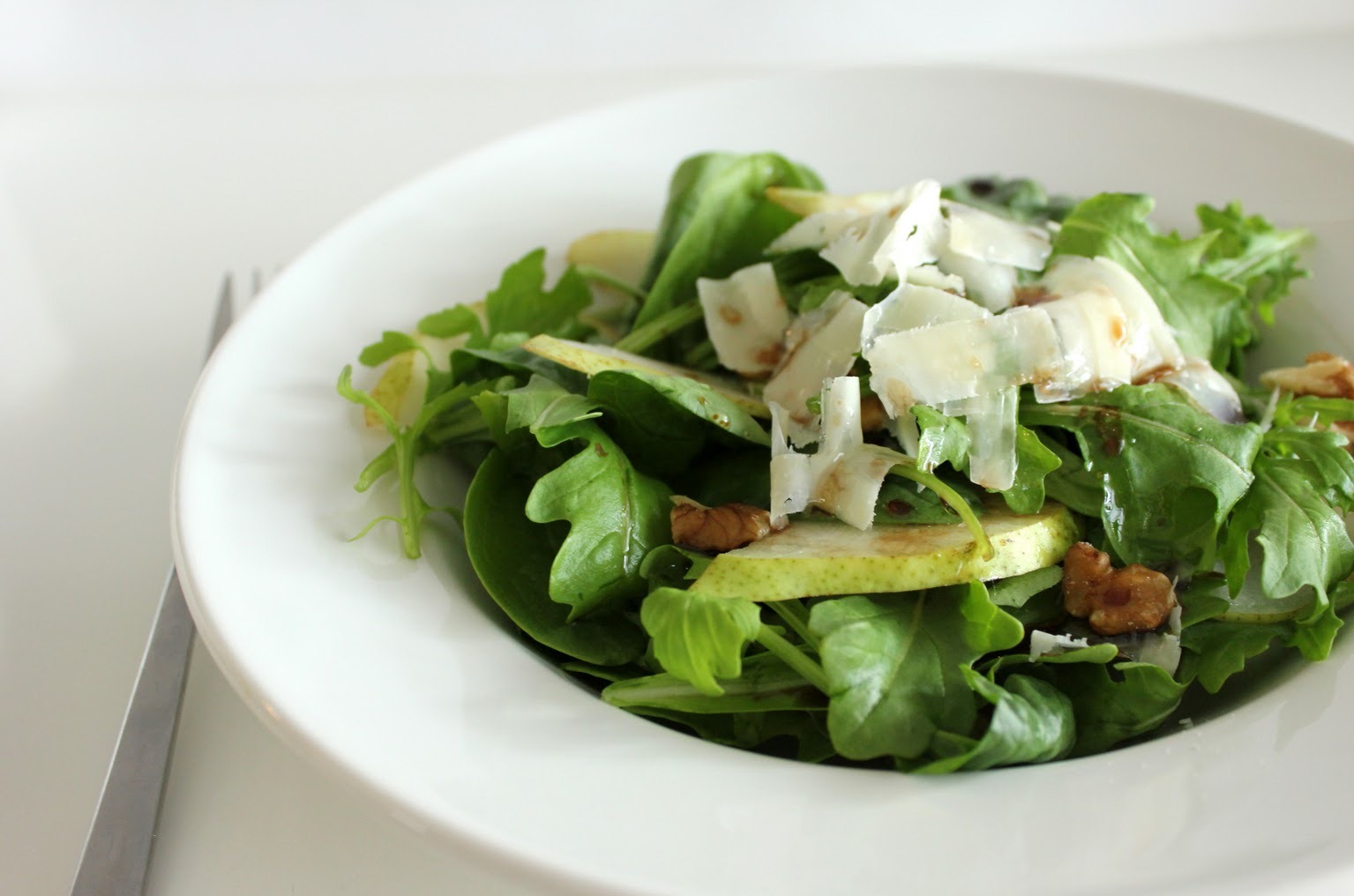
Pear and walnut salad

Red wine vinaigrette
3 corella (or other) ripe pears, skin on, quartered, cored and thinly sliced
150g watercress or rocket, stems removed
1 small red onion, thinly sliced into rings
90g walnuts, preferably Californian, roasted

Red wine vinaigrette

2 cloves garlic, crushed
1/3 lemon, juice only
100ml best red wine vinegar
300ml extra virgin olive oil
Sea salt and freshly ground pepper

 Combine garlic, lemon juice and vinegar in a bowl. Whisk in olive oil, then season to taste with salt and freshly ground black pepper. Makes about 400ml.

Eggs benedict

The recipe for this dish originated in America, I think at the Waldorf Hotel, where it is served on so-called ‘English muffins’. They don’t resemble English muffins at all. I would use sourdough or perhaps ciabatta for this dish, sliced fairly thickly and grilled.

4 generous slices ham from the bone, fat removed
4 thick slices of sourdough bread
Olive oil
8 eggs (these can be poached in advance and reheated as they would be in a restaurant situation)
Hollandaise sauce (see Sauces)
Cayenne pepper (optional)
Sea salt and freshly ground black pepper

Brush both sides of the sourdough slices with a little olive oil and place under a hot grill for 1 – 2 minutes each side until crisp and golden.

In a buttered heavy-based frying pan, lightly fry the ham to heat it through.

Top each slice of sourdough with a generous quantity of warm ham, top the ham with 2 reheated and well-drained poached eggs. Spoon hollandaise sauce over the eggs.

Sprinkle with cayenne pepper, then season with sea salt and freshly ground black pepper.

Serves 4.

Holandaise sauce

Like mayonnaise, Hollandaise and Béarnaise are emulsion sauces. Emulsion sauces are made with egg yolks, oil or fat and an acid to stablilise them. In the case of Hollandaise and Béarnaise, the fat is butter; with Hollandaise, the acid is lemon juice. Adding a teaspoon of the acid to the egg yolks before the fat is added helps prevent curdling and ensures a thick sauce.

Traditionally, all emulsion sauces are made in a double boiler, but both Hollandaise and Béarnaise can be made in a food processor. To finish the sauce you will need a double boiler, or a basin sitting in a saucepan of hot (but not boiling) water.

4 egg yolks
175g butter, melted, but not hot
1 tablespoon water
2 tablespoons lemon juice
Freshly ground black pepper

 Place egg yolks, water and a little of the lemon juice in the bowl of the food processor and, using the metal blade, process until light and well mixed. With the machine switched on, add the butter in a slow steady stream. Continue to process for another 30 seconds. Transfer the mixture to a double boiler, cook at low heat, but be careful not to let the water boil. Add a little cold water to the bottom of the double boiler frequently to keep it below boiling point. Stir the sauce constantly until it thickens to the consistency of custard. Add extra lemon juice to taste, but remember, too much lemon will spoil the sauce. Stir in the lemon juice well to stabilise the sauce. Add freshly ground pepper.

Hollandaise keeps in the refrigerator, but it does harden to the consistency of butter. Remove from the fridge well before serving time to soften it, or stand it in warm water. It may need to be whisked with a fork, or returned to the food processor for a few seconds. Should the sauce curdle, return it to the bowl of the food processor, switch on, and feed 1 – 2 tablespoons of boiling water through the feed tube, a little at a time.

Hollandaise sauce is traditionally served with asparagus or other vegetables, eggs and fish, especially salmon.

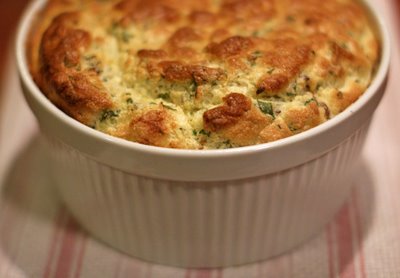
Goat’s cheese and hazelnut souffle

This is a really delicious recipe of Philip Johnson’s. It is also the one on which I came to grief one night when the mixture ‘split’ just as I was about to add the egg whites. The flour I should have been using was baker’s flour, or strong flour, which has a higher gluten (protein) content than the plain flour available on supermarket shelves. It is also the flour that many professional cooks use as a matter of course, so that when they say ‘plain flour’, they really mean baker’s flour.   

2 tablespoons unsalted butter, melted
½ cup polenta
50g unsalted butter
50g strong or baker’s flour
300ml cream
300ml milk
4 sprigs thyme, leaves chopped
Pinch nutmeg, freshly grated
Salt and freshly ground pepper
4 egg yolks
225g mature goat’s cheese, melted
6 egg whites
Pinch of cream of tartar (unless using a copper bowl for egg whites)
½ cup (50g) hazelnuts, roasted and finely chopped

Preheat oven to 220C, on static, not fan-forced setting.  Brush six 180ml capacity ceramic soufflé dishes with the melted butter and coat with polenta, shaking out the excess.

Melt the 50g butter in a heavy-based pan over moderate heat, then stir in flour. Cook and stir until mixture begins to leave the sides of the pan, then remove from heat. Gradually whisk in cream, then milk until smooth.

Bring mixture to the boil, stirring constantly. Cook for a further 5 minutes stirring occasionally.  Remove from heat and season with thyme, nutmeg, salt and black pepper to taste.

Whisk egg whites with a pinch of cream of tartar, unless you are using a copper bowl, in which case, omit the cream of tartar. Whites should be able to hold a peak without sagging. Using a metal spoon, fold one cup of the whites into soufflé mixture to loosen it, then fold in the remainder.

Divide mixture among soufflé dishes and scatter the tops with hazelnuts. Place dishes on an oven tray and bake until souffles are well risen and golden, about 15 – 20 minutes.

Serve immediately with a green salad. The pear and walnut salad included with the Goat’s Cheese Tart recipe in this section would be perfect.

Haloumi and zucchini fritters

I have made these for several art show openings and they have become a staple. They are always enormously popular, along with Turkish meatballs, crab and pork balls, and, of course, baked ricotta cake. (All, you will notice, can be made well in advance.) I feel that the zucchini fritters do need the aoili, though.

300g (about 6 – 8) zucchini
1 onion, grated
250g haloumi cheese, grated
75g (½ cup) plain flour
2 teaspoons zested lemon rind
2 eggs
1 tablespoon chopped fresh dill
Salt and freshly ground black pepper

Light olive oil, to fry
Aioli, to serve (see Sauces)

Coarsely grate the zucchinis, then squeeze out as much liquid as possible. Place in a bowl and add the onion, haloumi cheese, flour, lemon zest, eggs and dill. Season with salt and freshly ground black pepper and stir to combine. Shape the zucchini mixture into about 25 bite size patties. Refrigerate for about 30 minutes until firm.

Heat the oil in a heavy-based frying pan over medium heat and fry, in batches, for 1 – 2 minutes each side until golden. Drain on a paper towel.

Just before serving, place the fritters on a baking tray and warm in a pre-heated moderate oven.

Serve with aioli to dip.

Makes about 25.

Orange and passionfruit Yoyos (or melting moments)

These are the sort of delicious biscuits I remember as a child, only more so. (Though probably not as good.)  Serve with tea, or after dinner with coffee. Nobody ever said cheese was compulsory!

150g soft butter, chopped
75g (1/3 cup) caster sugar
2 teaspoons zested orange rind
200g plain flour
50g rice flour

 Passionfruit butter:

30g soft butter
80g (½ cup) icing sugar
1 tablespoon passionfruit pulp

 Beat butter, sugar and orange rind until light and fluffy. Stir in flours and, using a wooden spoon, mix until combined.

Knead gently on a lightly floured surface until smooth. Roll walnut-size pieces of dough into balls, place on greased baking trays and flatten with the back of a fork.

Bake at 180C for 10 – 15 minutes or until crisp and golden. Stand for 5 minutes before transferring to a wire rack to cool.

For passionfruit butter, beat butter until pale and creamy, add half the sugar and beat until well combined. Add passionfruit and remaining sugar and beat until well combined and fluffy.

Spread a small amount of passionfruit butter onto half the biscuits, then top with the remaining biscuits.

Makes about 16.