Cookbook

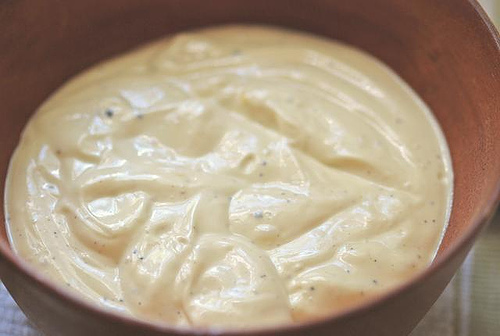
Mayonaise

Everybody should be able to make this simplest of the emulsion sauces without using a food processor, though I realise that, with the time constraints we all have, the food processor method will win every time. Make it by hand just once as it will help you to understand the properties of an egg yolk.

There are a few points to remember whether you are making mayonnaise by hand or with a food processor. If these are kept in mind, the dreaded ‘splitting’ can be avoided.

  • All ingredients should be at room temperature. Warm the bowl in which the mayonnaise is to be made in hot water before beginning and dry it thoroughly. This will take any chill off the egg yolks. Heat the oil to just tepid if it has been refrigerated.
  • The egg yolks must be well beaten for a minute or two before adding anything to them. This will help them absorb the oil better. A little of the acid, that is, the vinegar or lemon juice is then added. This seems to help the oil absorption. The remainder is added at the end.
  • The oil should be added very slowly at first, just drop by drop, until the emulsion process begins and the sauce incorporates into a heavy cream. After this the oil can be added more rapidly.
  • The maximum amount of oil one egg yolk can absorb is about ¾ cup (185ml, approximately). As soon as this volume of oil is exceeded, the mixture will curdle. It is better to measure out the oil for the number of eggs you are using before you begin than risk having to re-incorporate a curdled mess with additional egg yolks.

3 egg yolks
1 tablespoon white wine vinegar or lemon juice
½ teaspoon salt
½ teaspoon prepared Dijon mustard
500ml (2 cups) olive oil or a mixture of olive and other vegetable oil
2 tablespoons boiling water
Vinegar or lemon juice, extra
Dijon mustard, extra
Salt and freshly ground black pepper

Warm the mixing bowl in hot water and dry it thoroughly. Add the egg yolks and, using a wire whisk, beat yolks until they are thick and sticky.

Add the tablespoon vinegar or lemon juice, the salt and half teaspoon of mustard. Whisk for a further 30 seconds.

The eggs are now ready to receive the oil and while it goes in, drop by drop, you must not stop beating until the sauce has thickened. Add the drops of oil with a teaspoon, or rest the lip of the bottle on the edge of the bowl. Keep your eye on the oil rather than on the sauce.

Stop pouring, but continue beating every 10 seconds or so to be sure the yolks are absorbing the oil. After 1/3 – 2/3 cup of oil has been incorporated the sauce should thicken into a very heavy cream.

Once this has happened, the remaining oil may be added 1 tablespoon at a time, whisking well to incorporate between each addition.

If the sauce becomes too thick, thin it out with a few drops of lemon juice or vinegar, then continue adding the oil until all is incorporated.

Beat the boiling water into the mayonnaise. This is insurance against curdling.

Add extra vinegar or lemon juice and mustard to taste.

Season with salt and freshly ground black pepper.
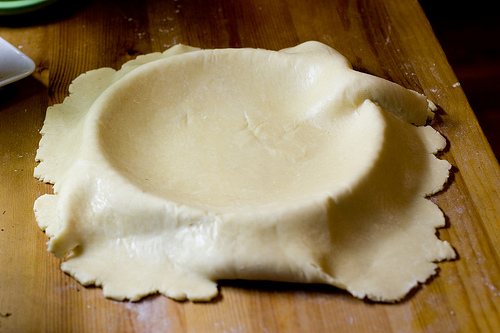
 

Before you begin: Pastry – a what’s what

I was sitting down having a cup of coffee and discussing recipes with Elly Hartland recently, when she asked me if I had made Philip Johnson’s goat’s cheese and leek pie. I asked her what was so special about it. “The pastry,” she said, “is so different. It isn’t a shortcrust pastry. It is an olive oil pastry. It’s flaky.”

“Pate brisee,” I thought, my heart dropping to my shoes, “uses olive oil.” I use it all the time and have always called it shortcrust pastry. But of course, it isn’t really shortcrust pastry at all! All those recipes are wrong!

Well, as it turned out, the goat’s cheese pie pastry isn’t even pate brisee; it is made entirely with olive oil and I don’t care for it much at all. But I was left with the fact that pate brisee is not shortcrust pastry.

Way back when you were all in kindergarten or pre-school, Simone Beck came to Brisbane for a series of cooking demonstrations and to promote her book ‘Simca’s Cuisine’. Simone Beck is best known, not for ‘Simca’s Cuisine’, but for co-authoring that two volume bible ‘Mastering the Art of French Cooking’. We were all very aware of her legendary importance in the world of haute cuisine and were suitably riveted. She made mushroom tartlets (Quichettes aux champignons).  They were delicious and became my stand-by recipe for many years, as you can see if you look at the state of p232 of ‘Simca’s Cuisine’. Pate brisee “A”, she grandly informed us, and Pate brisee “B”, are to be used for ALL savoury dishes. Obediently, I complied. Pate brisee “A” was fine by me; I have never tried “B”, which substitutes white wine for the water and a whole egg for the egg yolk. Perhaps I should.  She says the wine creates an interesting saveur.

Naturally, I then abandoned Nanya’s sweet shortcrust pastry for Simone Beck’s Pate sucree.

The funny thing about that day is that I swear Elly was with me. Obviously I was more impressed than she was!

Well, I have altered all those recipes, or I think I have.  Fortunately dessert tarts weren’t affected. Where, in savoury tarts, pies or quiches it once said ‘Shortcrust pastry’, it now should read ‘Pate brisee, shortcrust pastry or sour cream pastry’. I apologise.

Elly still doesn’t know that she ruined my day.

Chicken stock

Bought chicken stock in Australia has improved dramatically over the years and now Campbell’s and a few others are good to substitute. But the reality is, you really can’t beat homemade stocks and they are very easy – as long as you’ve got the space in your freezer to keep it, which is a constant problem for us.

Chicken frames, as many as you can comfortably fit in the stock pot
1 – 2 onions, roughly chopped
1 carrot, chopped
4 – 6 sticks celery roughly chopped
A handful of parsley
Water to cover
Freshly ground black pepper

Place the frames in a large stock pot, add the onion, carrot, celery and parsley and cover with water. Bring to the boil, then reduce heat, then cover and allow to simmer over very low heat for 5 – 6 hours if possible.

Strain, pressing the bones with the back of a spoon, to release all the juices. Transfer to a clean container and allow to cool. Refrigerate as soon as possible, then leave overnight until stock is completely cold and all fat has risen to the surface. De-grease the stock carefully. This is particularly important if you are making a consomme. The stock should be a thick jelly. Reheat just enough to liquefy the stock and pour into airtight containers, some of which should be no bigger than 250ml capacity.

Freeze when cool.

You will notice that I never add salt to chicken stock. I prefer to season the dish to which the stock is added.

Slow-roasted garlic & lemon chicken

IMG_0425

This recipe really has me hooked. It is so easy and delicious and also very adaptable. When you have had a little practice, you can throw your vegetables into the roasting pan with the chicken and other ingredients. We have done it very successfully with baby potatoes and artichoke hearts cut in half and chokes removed. An all time favourite is with baby fennel bulbs cut in half or quarters that end up deliciously caramelised with all the juices.

Slow-roasted garlic and lemon chicken was originally one of Nigella Lawson’s recipes, but I’m afraid her cooking times are far too long, her temperatures too high and the result totally inedible.

1 chicken (2 – 2.25 kg), cut into 10 pieces  or 4 chicken marylands or 8 chicken drumsticks
1 head of garlic, separated into unpeeled cloves
2 unwaxed lemons, cut into 8 wedges
A handful of fresh thyme
3 tablespoons olive oil
250ml white wine
Freshly ground black pepper

Preheat the oven 120C.

Put the chicken pieces into a roasting pan and add the garlic cloves and lemon wedges. Pull the leaves from most of the thyme stalks and sprinkle the leaves over the chicken. Retain the remaining thyme stalks to strew over the chicken later. Add the oil, then, using your hands, mix everything together, then spread the mixture out, making sure the chicken pieces are all skin-side up.

Sprinkle over the white wine and add the black pepper. Cover the chicken tightly with foil, and place in the oven for 1 hour.

Remove the foil from the roasting pan and increase the oven heat to 160C. Cook the uncovered chicken for another 30 – 45 minutes, by which time the skin of the chicken will have turned golden and the lemons will have begun to caramelise.

The vegetables can be added during the cooking time depending on how long you estimate they will take to cook.

Serves 4.

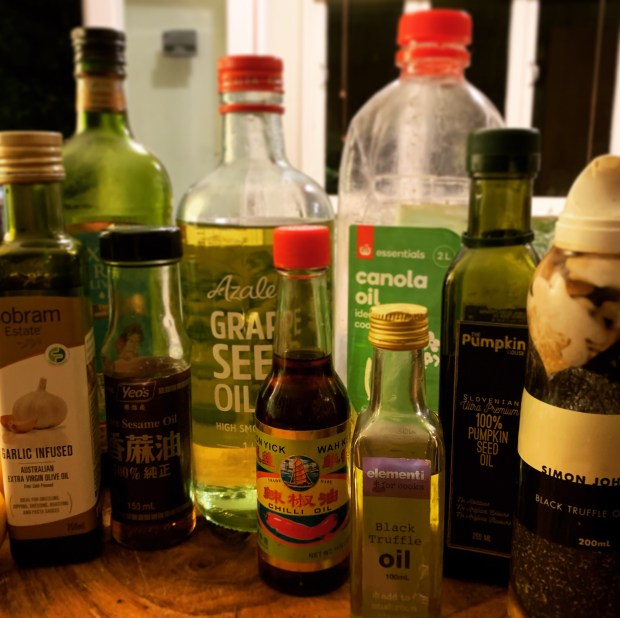
Before you begin – Oils

Oil. Think carefully about which oil to use in a recipe. In 1997, canola oil was considered to be the best oil to use health-wise. Cooking oils all contain saturated fats, mono-unsaturated fats and poly – unsaturated fats in varying proportions. Canola oil (and Grapeseed oil) has the biggest proportion of ‘good’ fats and the lowest proportion of ‘bad’ fats. In addition it also contains Omega 3 fatty acids, usually found in fish. These Omega 3 acids prevent the blood from clotting and are therefore considered very important in preventing heart disease. They are also important in reducing inflammation in some kinds of arthritis, in preventing asthma, in the development of the brain and in maintaining a healthy retina of the eye.

Less than a year later, some experts were saying that olive oil was the healthiest way to cook. To hedge my bets, I tend to cook with both…canola or grapseed oil for general cooking, seafood and Asian food, olive oil for all Mediterranean-style cooking. I still prefer the flavour (or rather the lack of it) of grape seed oil for fish cooking, and because grape seed oil rates fairly highly on the scale of ‘good oils’, I will still use it for cooking fish.

Ironically, however, in 2004 it was announced that vegetable oils, and in particular, canola oil was responsible for causing macular degeneration of the eye and was causing blindness in quite young people. So you can use butter and die of heart disease or use vegetable oil and go blind!

Once upon a time, I used peanut oil almost exclusively, and always for Asian cooking. These days I won’t even have it in the pantry. The incidence of peanut allergies has risen so dramatically over the last few decades that it is just not worth it.

Even the tiniest amount of peanut oil served to a person with a peanut allergy could result in death and I am just not prepared to take that risk.

I still use butter for some cooking. I cannot make a bechamel sauce without it, try as I might. I use butter for cooking liver as butter gives liver a better colour.

Just a word about olive oil. The flavour of olive oil is completely foreign to all Asian countries with the exception of Macau. (Macanese cuisine is a unique blend of Chinese and Portuguese cooking.) Most Asian cuisines use peanut (but see above) or sunflower oil. Canola oil is fine too. In Asian cooking the oil is simply a cooking medium; in Mediterranean cooking the flavour of the olive oil is important. Never use olive oil when preparing an Asian dish.

Olive oil is made by pressing the olives a number of times. The best oil comes from the first pressing. This is called ‘Extra Virgin’, and the oil produced is usually a fairly deep green. The second pressing produces ‘Virgin’ Olive oil, which is slightly lighter in colour. The third produces ‘Classic’ or ‘Classico’, which is usually a fairly deep gold in colour. Then come the final pressings producing ‘Light’ and ‘Extra Light’ Olive Oil. These are generally despised by the true Italian and Provencal cooks, but for our tastes, they are less overpowering than the earlier pressings. All are pure oil and all contain the same amount of fat. It is a flavour choice, not a health choice. Extra virgin olive oil contains the same amount of fat as extra light olive oil.

It is a myth that adding oil to the water when cooking pasta stops the pasta from sticking. All it does is inhibit the ability of the pasta sauce from adhering to the pasta.