recipes

Red duck curry made from barbeque duck

We usually make red curry of duck with the meat of a barbecued duck purchased from Chinatown after the duck has been relieved of its skin for duck pancakes. There is no reason why you should not use a duck you have cooked yourself, and there is no reason why the skin shouldn’t go into the curry! That said, the spices added to a Chinatown duck do give it an extra dimension – and of course it is so much easier!

This is a Thai curry and Thai curries don’t normally have vegetables in them. However somehow onion wedges seem to have crept into ours and they do give the curry a nice crunch.

For the sweet element, we use either lychees in syrup or John West mandarin segments in syrup. Both work well.

1 onion, peeled and cut into thin wedges
1 tablespoon vegetable oil
1 x 400ml can coconut cream
1 x 400ml can coconut milk
1½ tablespoons Thai red curry paste
Meat (and skin, optional) from 1 Chinese roast duck, cut into bite size pieces
1 tablespoon fish sauce (or to taste)
1 can lychees in syrup, or 1 can mandarins in syrup
A few kaffir lime leaves
1 tablespoon coriander, roots, stems and leaves finely chopped

Heat the vegetable oil in a wok and cook the onion wedges until transparent but still crunchy. Remove from wok and set aside. Tip excess oil from the wok.

Tip the coconut cream into the wok and cook until it cracks. (Cook until the oil separates from the cream.) Add the red curry paste and cook for about 1 minute, then gradually add the coconut milk. Bring slowly to the boil.

Drain the lychees or mandarins but don’t discard the liquid.

Add the reserved onion wedges, the duck meat, the lychees or mandarins (but not the syrup), the fish sauce, kaffir lime leaves and coriander.

Test for balance of flavours. If not salty enough, add more fish sauce. If not sweet enough, add a little of the syrup from the fruit.

Serve with jasmine rice.
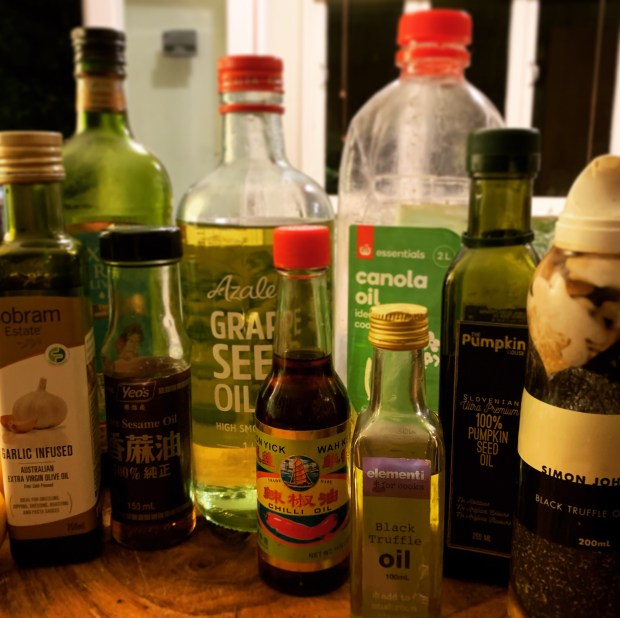
 

Before you begin – Oils

Oil. Think carefully about which oil to use in a recipe. In 1997, canola oil was considered to be the best oil to use health-wise. Cooking oils all contain saturated fats, mono-unsaturated fats and poly – unsaturated fats in varying proportions. Canola oil (and Grapeseed oil) has the biggest proportion of ‘good’ fats and the lowest proportion of ‘bad’ fats. In addition it also contains Omega 3 fatty acids, usually found in fish. These Omega 3 acids prevent the blood from clotting and are therefore considered very important in preventing heart disease. They are also important in reducing inflammation in some kinds of arthritis, in preventing asthma, in the development of the brain and in maintaining a healthy retina of the eye.

Less than a year later, some experts were saying that olive oil was the healthiest way to cook. To hedge my bets, I tend to cook with both…canola or grapseed oil for general cooking, seafood and Asian food, olive oil for all Mediterranean-style cooking. I still prefer the flavour (or rather the lack of it) of grape seed oil for fish cooking, and because grape seed oil rates fairly highly on the scale of ‘good oils’, I will still use it for cooking fish.

Ironically, however, in 2004 it was announced that vegetable oils, and in particular, canola oil was responsible for causing macular degeneration of the eye and was causing blindness in quite young people. So you can use butter and die of heart disease or use vegetable oil and go blind!

Once upon a time, I used peanut oil almost exclusively, and always for Asian cooking. These days I won’t even have it in the pantry. The incidence of peanut allergies has risen so dramatically over the last few decades that it is just not worth it.

Even the tiniest amount of peanut oil served to a person with a peanut allergy could result in death and I am just not prepared to take that risk.

I still use butter for some cooking. I cannot make a bechamel sauce without it, try as I might. I use butter for cooking liver as butter gives liver a better colour.

Just a word about olive oil. The flavour of olive oil is completely foreign to all Asian countries with the exception of Macau. (Macanese cuisine is a unique blend of Chinese and Portuguese cooking.) Most Asian cuisines use peanut (but see above) or sunflower oil. Canola oil is fine too. In Asian cooking the oil is simply a cooking medium; in Mediterranean cooking the flavour of the olive oil is important. Never use olive oil when preparing an Asian dish.

Olive oil is made by pressing the olives a number of times. The best oil comes from the first pressing. This is called ‘Extra Virgin’, and the oil produced is usually a fairly deep green. The second pressing produces ‘Virgin’ Olive oil, which is slightly lighter in colour. The third produces ‘Classic’ or ‘Classico’, which is usually a fairly deep gold in colour. Then come the final pressings producing ‘Light’ and ‘Extra Light’ Olive Oil. These are generally despised by the true Italian and Provencal cooks, but for our tastes, they are less overpowering than the earlier pressings. All are pure oil and all contain the same amount of fat. It is a flavour choice, not a health choice. Extra virgin olive oil contains the same amount of fat as extra light olive oil.

It is a myth that adding oil to the water when cooking pasta stops the pasta from sticking. All it does is inhibit the ability of the pasta sauce from adhering to the pasta.