Month: February 2012

Before you begin: Pastry – a what’s what

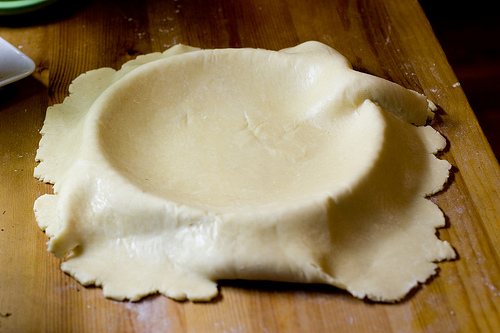
I was sitting down having a cup of coffee and discussing recipes with Elly Hartland recently, when she asked me if I had made Philip Johnson’s goat’s cheese and leek pie. I asked her what was so special about it. “The pastry,” she said, “is so different. It isn’t a shortcrust pastry. It is an olive oil pastry. It’s flaky.”

“Pate brisee,” I thought, my heart dropping to my shoes, “uses olive oil.” I use it all the time and have always called it shortcrust pastry. But of course, it isn’t really shortcrust pastry at all! All those recipes are wrong!

Well, as it turned out, the goat’s cheese pie pastry isn’t even pate brisee; it is made entirely with olive oil and I don’t care for it much at all. But I was left with the fact that pate brisee is not shortcrust pastry.

Way back when you were all in kindergarten or pre-school, Simone Beck came to Brisbane for a series of cooking demonstrations and to promote her book ‘Simca’s Cuisine’. Simone Beck is best known, not for ‘Simca’s Cuisine’, but for co-authoring that two volume bible ‘Mastering the Art of French Cooking’. We were all very aware of her legendary importance in the world of haute cuisine and were suitably riveted. She made mushroom tartlets (Quichettes aux champignons).  They were delicious and became my stand-by recipe for many years, as you can see if you look at the state of p232 of ‘Simca’s Cuisine’. Pate brisee “A”, she grandly informed us, and Pate brisee “B”, are to be used for ALL savoury dishes. Obediently, I complied. Pate brisee “A” was fine by me; I have never tried “B”, which substitutes white wine for the water and a whole egg for the egg yolk. Perhaps I should.  She says the wine creates an interesting saveur.

Naturally, I then abandoned Nanya’s sweet shortcrust pastry for Simone Beck’s Pate sucree.

The funny thing about that day is that I swear Elly was with me. Obviously I was more impressed than she was!

Well, I have altered all those recipes, or I think I have.  Fortunately dessert tarts weren’t affected. Where, in savoury tarts, pies or quiches it once said ‘Shortcrust pastry’, it now should read ‘Pate brisee, shortcrust pastry or sour cream pastry’. I apologise.

Elly still doesn’t know that she ruined my day.

Chicken stock

Bought chicken stock in Australia has improved dramatically over the years and now Campbell’s and a few others are good to substitute. But the reality is, you really can’t beat homemade stocks and they are very easy – as long as you’ve got the space in your freezer to keep it, which is a constant problem for us.

Chicken frames, as many as you can comfortably fit in the stock pot
1 – 2 onions, roughly chopped
1 carrot, chopped
4 – 6 sticks celery roughly chopped
A handful of parsley
Water to cover
Freshly ground black pepper

Place the frames in a large stock pot, add the onion, carrot, celery and parsley and cover with water. Bring to the boil, then reduce heat, then cover and allow to simmer over very low heat for 5 – 6 hours if possible.

Strain, pressing the bones with the back of a spoon, to release all the juices. Transfer to a clean container and allow to cool. Refrigerate as soon as possible, then leave overnight until stock is completely cold and all fat has risen to the surface. De-grease the stock carefully. This is particularly important if you are making a consomme. The stock should be a thick jelly. Reheat just enough to liquefy the stock and pour into airtight containers, some of which should be no bigger than 250ml capacity.

Freeze when cool.

You will notice that I never add salt to chicken stock. I prefer to season the dish to which the stock is added.

Potato, leek and jerusalem artichoke soup

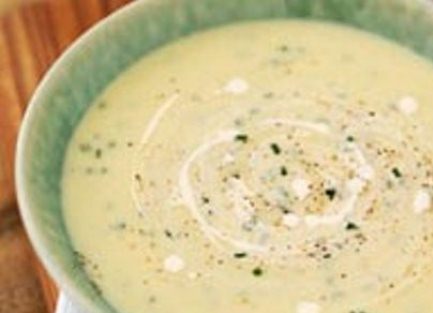
Probably this soup should be called Potato and Leek Soup with Jerusalem Artichoke, because once you add the Jerusalem artichokes, it is not, technically, a Vichysoisse.

However…

Jerusalem artichokes are winter vegetables, so probably lend themselves to hot soups rather than cold, so it is not really a Vichysoisse anyway, if you follow my reasoning. Whatever you want to call it the variation is a delicious one. Jerusalem artichokes are not a bit like the globe artichokes that Kate would almost kill for. They look like a cross between fresh ginger and a very knobbly potato and have a stunning flavour like nothing else. When you add it, someone always asks, “What is the wonderful flavour in this soup?”

To make, simply add 3-4 (or more, if you find the flavour addictive) Jerusalem artichokes to the Vichysoisse recipe above. Peel them and treat them exactly as you would the potatoes.

Vichyssoise (potato and leek soup)


6 – 8 good big leeks, carefully washed
8 big old potatoes
Oil for cooking
A good quantity of rich chicken stock, preferably homemade
Cream
Salt and freshly ground pepper
A little lemon juice, if required

Finely slice the leeks, white part only; peel the potatoes, and cut into manageable portions.

Heat oil in a heavy based frying pan, add the leeks and sauté until tender. Remove the leeks into a large saucepan or casserole, add potatoes to pan and toss in the remaining oil, allowing them to cook just a little. Add the potatoes to the leeks, cover with chicken stock, and allow them to simmer gently until the potatoes are tender.

Puree the potato and leek mixture in a food processor, or pass through a mouli. Return to a clean saucepan, and add additional chicken stock until the soup is the required consistency. Add a little lemon juice if required. Season to taste.

Vichyssoise is traditionally served cold, though it is delicious hot as well. Remember, though, that if it is frozen, it will lose its smooth consistency, which can only be regained by reheating. So if you intend serving it cold, it should not be frozen.

Before serving, stir the cream into the soup. Be careful not to add too much, which will make the soup unpleasantly rich. Alternatively, serve the soup as is, and add a swirl of cream to the bowl.

The flavour of a good vichyssoise is determined by the quality of the chicken stock, so if possible, use homemade stock

Slow-roasted garlic & lemon chicken

IMG_0425

This recipe really has me hooked. It is so easy and delicious and also very adaptable. When you have had a little practice, you can throw your vegetables into the roasting pan with the chicken and other ingredients. We have done it very successfully with baby potatoes and artichoke hearts cut in half and chokes removed. An all time favourite is with baby fennel bulbs cut in half or quarters that end up deliciously caramelised with all the juices.

Slow-roasted garlic and lemon chicken was originally one of Nigella Lawson’s recipes, but I’m afraid her cooking times are far too long, her temperatures too high and the result totally inedible.

1 chicken (2 – 2.25 kg), cut into 10 pieces  or 4 chicken marylands or 8 chicken drumsticks
1 head of garlic, separated into unpeeled cloves
2 unwaxed lemons, cut into 8 wedges
A handful of fresh thyme
3 tablespoons olive oil
250ml white wine
Freshly ground black pepper

Preheat the oven 120C.

Put the chicken pieces into a roasting pan and add the garlic cloves and lemon wedges. Pull the leaves from most of the thyme stalks and sprinkle the leaves over the chicken. Retain the remaining thyme stalks to strew over the chicken later. Add the oil, then, using your hands, mix everything together, then spread the mixture out, making sure the chicken pieces are all skin-side up.

Sprinkle over the white wine and add the black pepper. Cover the chicken tightly with foil, and place in the oven for 1 hour.

Remove the foil from the roasting pan and increase the oven heat to 160C. Cook the uncovered chicken for another 30 – 45 minutes, by which time the skin of the chicken will have turned golden and the lemons will have begun to caramelise.

The vegetables can be added during the cooking time depending on how long you estimate they will take to cook.

Serves 4.

Red duck curry made from barbeque duck

We usually make red curry of duck with the meat of a barbecued duck purchased from Chinatown after the duck has been relieved of its skin for duck pancakes. There is no reason why you should not use a duck you have cooked yourself, and there is no reason why the skin shouldn’t go into the curry! That said, the spices added to a Chinatown duck do give it an extra dimension – and of course it is so much easier!

This is a Thai curry and Thai curries don’t normally have vegetables in them. However somehow onion wedges seem to have crept into ours and they do give the curry a nice crunch.

For the sweet element, we use either lychees in syrup or John West mandarin segments in syrup. Both work well.

1 onion, peeled and cut into thin wedges
1 tablespoon vegetable oil
1 x 400ml can coconut cream
1 x 400ml can coconut milk
1½ tablespoons Thai red curry paste
Meat (and skin, optional) from 1 Chinese roast duck, cut into bite size pieces
1 tablespoon fish sauce (or to taste)
1 can lychees in syrup, or 1 can mandarins in syrup
A few kaffir lime leaves
1 tablespoon coriander, roots, stems and leaves finely chopped

Heat the vegetable oil in a wok and cook the onion wedges until transparent but still crunchy. Remove from wok and set aside. Tip excess oil from the wok.

Tip the coconut cream into the wok and cook until it cracks. (Cook until the oil separates from the cream.) Add the red curry paste and cook for about 1 minute, then gradually add the coconut milk. Bring slowly to the boil.

Drain the lychees or mandarins but don’t discard the liquid.

Add the reserved onion wedges, the duck meat, the lychees or mandarins (but not the syrup), the fish sauce, kaffir lime leaves and coriander.

Test for balance of flavours. If not salty enough, add more fish sauce. If not sweet enough, add a little of the syrup from the fruit.

Serve with jasmine rice.


Peking duck pancakes

True Peking duck pancakes are, of course the first part of three that are served when you order Peking duck at an Australian restaurant. (In China, I understand, the skin is cut from the duck, and the meat removed from the bones and cut into small rectangles. These are then arranged on a serving platter, between the legs and the wings to create a symbolic whole duck. The bones are then made into duck soup. Pieces of meat as well as skin can be rolled into Chinese pancakes much as they are served here.)

We make Peking duck pancakes at home really only when we intend to make a red duck curry from the meat of a barbecued duck bought from Chinatown, because the skin is not required for red duck curry. Given what you pay in a restaurant for this as a starter, it’s such a waste not to do it for guests.

If I were intending to serve duck pancakes as finger food for a party, I would probably use tiny savoury pancakes instead of the true steamed Chinese ones, and might top the pancakes with duck meat, rather than duck skin, and slivers of fruit, or with plum sauce instead of the traditional hoisin sauce.

1 barbecued duck from Chinatown
1 packet Chinese pancakes from Chinese barbecue in Chinatown
1 bunch green onions
Hoisin sauce

Firstly, prepare the green onions. These can be simply be cut into strips, or they can be “frilled”. To do this, cut the white part of the green onion into approximately 4cm lengths, then with a sharp knife, cut 1.5cm deep slits all around both ends of the green onion, leaving about 1 cm of solid green onion in the centre. Place them in a bowl of iced water and leave them in the refrigerator for about an hour. The ends will curl and stiffen making balls of green-white ‘frills’.

We have recently discovered that re-heating the duck helps to separate the skin from the meat and also helps to re-crisp the skin. Pre-heat the oven to 160 degrees and wrap the duck in al-foil. Reheat in the oven for approximately 15 minutes. Remove from the oven and using a flexible knife, cut the skin away from the duck. Don’t pull it as it will tear. The skin should have some meat attached.

Heat the pancakes by folding them in half and placing the folded pancakes onto a plate and steaming them in a traditional Chinese bamboo steamer, or by placing them in a microwave steamer (with water) for about two minutes.

To serve, smear a pancake with hoisin sauce. Place a piece of duck skin onto the pancake, top   with a green onion strip or frill, roll up and serve.

Cheese Biscuits #1

Cheese biscuits neverendingcookbook

I think a little cheese biscuit with a drink when ones’ guests arrive is a perfect way to begin any party. The Moreton Club has done these tiny biscuits for years and whilst I believe that the recipe is available I do not know anybody who actually has it.

I am enormously proud of this recipe because it is the result of a lot of hard work and much experimentation. I think my recipe is a little better than the Moreton Club’s. Lately it is my most requested recipe, which does say something!

This recipe has the added advantage of having equal quantities of butter, flour and cheese which makes it very easy to remember, and very easy to make in smaller or larger quantities.  When I began experimenting with these biscuits, the flour was all plain flour. Then it became plain flour with a little rice flour added, then plain flour with a little ground rice. Now I make them with equal quantities of plain flour and ground rice. This gives the biscuits a very satisfying crunch.

250g butter
250g imported Parmesan cheese, finely grated
125g plain flour
125g ground rice (or substitute rice flour)
Cayenne pepper

Sift together the plain flour, cayenne pepper and ground rice or rice flour. Cut butter into small cubes and place in the bowl of a food processor. Add sifted flour/s and cayenne and the finely grated Parmesan. Process until the mixture forms a ball around the shaft of the food processor. Remove biscuit dough from food processor and wrap in plastic film. Refrigerate dough for 1 hour.

Preheat oven to 120C.

Grease a baking sheet or baking tray with butter and, using hands, roll biscuit dough into balls approximately 1 cm in diameter. Place on the baking tray and press balls with a fork to flatten and decorate.

Bake for 10 – 15 minutes, or until the biscuits are lightly coloured. As soon as you can smell the cheese in the biscuits they are almost done.

Cool on a wire rack until completely cold, then store in an airtight container into which some kitchen paper has been placed. If biscuits are not needed for a week or two, seal the airtight container with tape.

To serve, reheat at very low temperature on baking sheet until biscuits are warm but not hot.

Vodka Berry Ice

200g frozen raspberries, thawed
150g caster sugar
100ml vodka or aquavit
1 tablespoon lemon juice

Puree thawed raspberries.

In a small pan, melt sugar in 2 cups (500ml) water over low heat. Increase heat and bring to the boil. Keep at a high simmer for 5 – 10 minutes until syrupy. Remove from heat and allow to cool. When cool, stir in alcohol, lemon juice and raspberry puree.

Strain into a freezer-safe container, then freeze for several hours until the edges start to set. Remove and stir vigorously with a fork.

Repeat this process 2 – 3 times every 90 minutes. Ice will become thick and slushy, with very fine crystals.

To serve, remove from freezer to soften slightly. Serve in chilled glasses or bowls with spoons.


French apple tart

This recipe has saved me on several occasions when a dessert is needed at short notice. Use bought short-crust pastry shells if you are really short of time, or make your own and bake blind before adding the filling. Both keep well in the freezer and are useful in emergencies. This tart is quite delicious and if you don’t let your guests see the foil container the bought case came in, they will never know the difference!

1 x 15cm sweet short-crust pastry (pate sucre) shell, baked blind

1½ – 2 Granny Smith apples
2½ tablespoons brown sugar (not the very dark variety)
1 – 1½ tablespoons plain flour
1 level teaspoon ground nutmeg
1 level teaspoon ground cinnamon
1 tablespoon slivered almonds (optional)
½ – 1 cup pure cream

Peel, core and slice the apples, and place in a bowl. Add the sugar, flour, nutmeg, cinnamon and slivered almonds (if using) and toss together gently until well blended. Tip into the pastry shell and even mixture out.

Add as much cream as needed to cover the apple mixture without over-filling the shell.

Preheat the oven to 190C and bake for approximately 40 minutes.

Serve hot with cream or crème fraiche.