Vegetarian

Before you begin – soy sauce

Soy Sauce. Not so very long ago you could simply buy a bottle of ‘soya sauce’. There were, in fact two other sauces available, produced by Conimex and called ‘bentang ketjap manis’ and ‘bentang ketjap asin’. You did not have to be a genius to work out that ‘manis’ meant ‘sweet’ and ‘asin’ meant ‘salty’. I am not sure that it occurred to any of us that bentang ketjap was simply Indonesian soy sauce and that sweet and salty were two preferred Indonesian varieties. The point I am making is that each country in Asia has its own version of soy sauce made from soy beans. They are not interchangeable. Using bentang ketjap manis in Japanese cooking instead of Japanese shoyu is absolutely unthinkable. Chinese soy sauce is not a convenient catch all for all other Asian countries’ versions of soy sauce, although I found Korean soy very similar to Chinese soy in some cases, and more like Japanese shoyu in others. Not surprising, I suppose when you consider where Korea is situated.

The problem is further complicated by the fact that every Asian country has different kinds of soy sauce. China, Korea, Japan, Thailand and Vietnam all have dark and light soy sauces. Those of Thailand and Vietnam are fairly interchangeable, as are those of China and Korea. I am not sure about Malaysia. Geok uses Chinese soy sauce, but then her parents were Chinese. I suspect that many Malays use a soy sauce similar to that used by the Indonesians, in which case the two main kinds are sweet and salty, rather than light and dark.

As a general rule, use light soy sauce with seafood, poultry and white meats, dark soy sauce when cooking red meat.

Goats cheese, parmesan, leek and thyme tart

I first made this tart (or quiche, though I have noticed that men don’t like eating quiches, though they don’t mind tarts!) for a ‘plein air’ day at my landscape painting class. It was a huge success, and I had to print out twelve copies of the recipe. It appears below exactly as I typed it. The cheese references are for the people who hadn’t a clue what goat’s cheese was and firmly believed that Parmesan was smelly grated cheese that came in a green shaker!

1 x savoury shortcrust pastry base, frozen then baked blind in a 25cm diameter x 3.5cm deep flan tin with a removable base or a pate brisee base.

Filling:
6 medium sized leeks, well washed and finely sliced (white part only)
A little butter
1 tablespoon light olive oil
1 round goats’ cheese (125g) *
150g good Parmesan cheese, grated **
A good handful of fresh thyme leaves, stems removed
6 – 7 eggs
1 ½ cups (375ml) pouring cream
A little freshly grated nutmeg
Salt
Freshly ground black pepper

Heat olive oil and butter in a heavy-based frying pan until the butter sizzles. Reduce heat and add the finely sliced leeks. Stir so that they don’t catch and continue to cook until leeks are transparent and tender. Remove from heat and place in a colander or sieve to drain well.

Preheat the oven to 200C, or a little hotter.

Sprinkle about one third of the Parmesan cheese evenly onto the tart base, then add the leeks, making sure they cover the base, right to the edges. Add some of the thyme leaves.

Slice or crumble (depending its consistency  – see note below) the goats’ cheese and distribute it evenly, then top with the remaining Parmesan cheese and the remaining thyme.

Season with salt and freshly ground pepper.

Break 6 of the eggs into a bowl and beat until an even consistency. Add a scant 1¼

cups of cream and beat together lightly. (Hold the remaining egg and cream until you know if you need them.) Add a little freshly grated nutmeg, then pour the mixture carefully into the tart, taking care not to overfill. If you don’t have enough egg/cream mixture, beat together the remaining egg and cream and add.

Place the tart tin onto a baking tray. (This will make it easier to remove without accidentally pushing the base of the tin up and so breaking the hot tart. It will also prevent any of the egg and cream mixture that might leak from ending up on the floor of your oven.)

Bake at 200C for 20 – 25 minutes, or until the top is a nice golden colour or the quiche is set.

Pate brisee

For years this has been the recipe I reach for whenever a savoury pastry shell is called for. 

Pate brisee (broken pastry) gives a slightly flaky crust without a strong individual taste, which makes it perfect for savoury flans, pies and quiches.  

These quantities make enough for one 25cm diameter quiche, or 20 tartlet moulds, each 5 cm in diameter and 1cm deep

100g chilled butter
225g plain flour
1 egg yolk
3 tablespoons cold water
1 tablespoon oil
Pinch of salt

Cut the chilled butter into small pieces and put the butter into a mixing bowl with the flour and the salt. Using a fork, or two knives, work the butter into the flour until the mixture has the texture of oatmeal.

Beat the egg yolk with the cold water and add the oil. Make a well in the centre of the flour and butter mixture and pour in the oil. Mix with a fork, then use your hands to form the dough into a ball.

If using a food processor, place the flour and salt into the bowl and add butter cut into small pieces. Using the metal blade, process until the mixture has the texture of oatmeal.

Beat egg yolk with the cold water, and add the oil. With the processor switched on, add the egg mixture through the feed tube, processing until the mixture forms a ball around the blade. Switch off immediately.

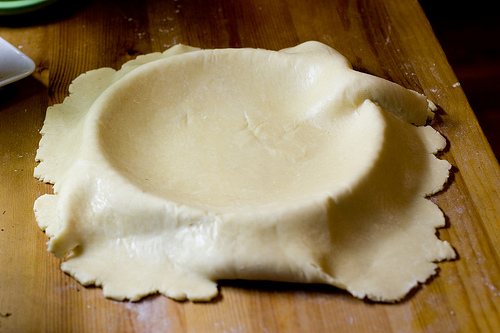
Wrap the pastry in waxed paper and refrigerate until firm…at least 20 minutes. This mixture will keep for weeks in the freezer.

If recipe specifies that a pastry shell be ‘blind baked’ before filling, follow the instructions in ‘Blind Baking a Pastry Tart Shell’ in this section.

Holandaise sauce

Like mayonnaise, Hollandaise and Béarnaise are emulsion sauces. Emulsion sauces are made with egg yolks, oil or fat and an acid to stablilise them. In the case of Hollandaise and Béarnaise, the fat is butter; with Hollandaise, the acid is lemon juice. Adding a teaspoon of the acid to the egg yolks before the fat is added helps prevent curdling and ensures a thick sauce.

Traditionally, all emulsion sauces are made in a double boiler, but both Hollandaise and Béarnaise can be made in a food processor. To finish the sauce you will need a double boiler, or a basin sitting in a saucepan of hot (but not boiling) water.

4 egg yolks
175g butter, melted, but not hot
1 tablespoon water
2 tablespoons lemon juice
Freshly ground black pepper

 Place egg yolks, water and a little of the lemon juice in the bowl of the food processor and, using the metal blade, process until light and well mixed. With the machine switched on, add the butter in a slow steady stream. Continue to process for another 30 seconds. Transfer the mixture to a double boiler, cook at low heat, but be careful not to let the water boil. Add a little cold water to the bottom of the double boiler frequently to keep it below boiling point. Stir the sauce constantly until it thickens to the consistency of custard. Add extra lemon juice to taste, but remember, too much lemon will spoil the sauce. Stir in the lemon juice well to stabilise the sauce. Add freshly ground pepper.

Hollandaise keeps in the refrigerator, but it does harden to the consistency of butter. Remove from the fridge well before serving time to soften it, or stand it in warm water. It may need to be whisked with a fork, or returned to the food processor for a few seconds. Should the sauce curdle, return it to the bowl of the food processor, switch on, and feed 1 – 2 tablespoons of boiling water through the feed tube, a little at a time.

Hollandaise sauce is traditionally served with asparagus or other vegetables, eggs and fish, especially salmon.

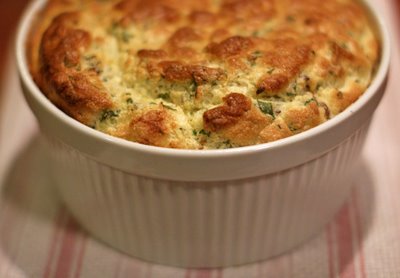
Goat’s cheese and hazelnut souffle

This is a really delicious recipe of Philip Johnson’s. It is also the one on which I came to grief one night when the mixture ‘split’ just as I was about to add the egg whites. The flour I should have been using was baker’s flour, or strong flour, which has a higher gluten (protein) content than the plain flour available on supermarket shelves. It is also the flour that many professional cooks use as a matter of course, so that when they say ‘plain flour’, they really mean baker’s flour.   

2 tablespoons unsalted butter, melted
½ cup polenta
50g unsalted butter
50g strong or baker’s flour
300ml cream
300ml milk
4 sprigs thyme, leaves chopped
Pinch nutmeg, freshly grated
Salt and freshly ground pepper
4 egg yolks
225g mature goat’s cheese, melted
6 egg whites
Pinch of cream of tartar (unless using a copper bowl for egg whites)
½ cup (50g) hazelnuts, roasted and finely chopped

Preheat oven to 220C, on static, not fan-forced setting.  Brush six 180ml capacity ceramic soufflé dishes with the melted butter and coat with polenta, shaking out the excess.

Melt the 50g butter in a heavy-based pan over moderate heat, then stir in flour. Cook and stir until mixture begins to leave the sides of the pan, then remove from heat. Gradually whisk in cream, then milk until smooth.

Bring mixture to the boil, stirring constantly. Cook for a further 5 minutes stirring occasionally.  Remove from heat and season with thyme, nutmeg, salt and black pepper to taste.

Whisk egg whites with a pinch of cream of tartar, unless you are using a copper bowl, in which case, omit the cream of tartar. Whites should be able to hold a peak without sagging. Using a metal spoon, fold one cup of the whites into soufflé mixture to loosen it, then fold in the remainder.

Divide mixture among soufflé dishes and scatter the tops with hazelnuts. Place dishes on an oven tray and bake until souffles are well risen and golden, about 15 – 20 minutes.

Serve immediately with a green salad. The pear and walnut salad included with the Goat’s Cheese Tart recipe in this section would be perfect.

Haloumi and zucchini fritters

I have made these for several art show openings and they have become a staple. They are always enormously popular, along with Turkish meatballs, crab and pork balls, and, of course, baked ricotta cake. (All, you will notice, can be made well in advance.) I feel that the zucchini fritters do need the aoili, though.

300g (about 6 – 8) zucchini
1 onion, grated
250g haloumi cheese, grated
75g (½ cup) plain flour
2 teaspoons zested lemon rind
2 eggs
1 tablespoon chopped fresh dill
Salt and freshly ground black pepper

Light olive oil, to fry
Aioli, to serve (see Sauces)

Coarsely grate the zucchinis, then squeeze out as much liquid as possible. Place in a bowl and add the onion, haloumi cheese, flour, lemon zest, eggs and dill. Season with salt and freshly ground black pepper and stir to combine. Shape the zucchini mixture into about 25 bite size patties. Refrigerate for about 30 minutes until firm.

Heat the oil in a heavy-based frying pan over medium heat and fry, in batches, for 1 – 2 minutes each side until golden. Drain on a paper towel.

Just before serving, place the fritters on a baking tray and warm in a pre-heated moderate oven.

Serve with aioli to dip.

Makes about 25.

Orange and passionfruit Yoyos (or melting moments)

These are the sort of delicious biscuits I remember as a child, only more so. (Though probably not as good.)  Serve with tea, or after dinner with coffee. Nobody ever said cheese was compulsory!

150g soft butter, chopped
75g (1/3 cup) caster sugar
2 teaspoons zested orange rind
200g plain flour
50g rice flour

 Passionfruit butter:

30g soft butter
80g (½ cup) icing sugar
1 tablespoon passionfruit pulp

 Beat butter, sugar and orange rind until light and fluffy. Stir in flours and, using a wooden spoon, mix until combined.

Knead gently on a lightly floured surface until smooth. Roll walnut-size pieces of dough into balls, place on greased baking trays and flatten with the back of a fork.

Bake at 180C for 10 – 15 minutes or until crisp and golden. Stand for 5 minutes before transferring to a wire rack to cool.

For passionfruit butter, beat butter until pale and creamy, add half the sugar and beat until well combined. Add passionfruit and remaining sugar and beat until well combined and fluffy.

Spread a small amount of passionfruit butter onto half the biscuits, then top with the remaining biscuits.

Makes about 16.

Before you begin: Pastry – a what’s what

I was sitting down having a cup of coffee and discussing recipes with Elly Hartland recently, when she asked me if I had made Philip Johnson’s goat’s cheese and leek pie. I asked her what was so special about it. “The pastry,” she said, “is so different. It isn’t a shortcrust pastry. It is an olive oil pastry. It’s flaky.”

“Pate brisee,” I thought, my heart dropping to my shoes, “uses olive oil.” I use it all the time and have always called it shortcrust pastry. But of course, it isn’t really shortcrust pastry at all! All those recipes are wrong!

Well, as it turned out, the goat’s cheese pie pastry isn’t even pate brisee; it is made entirely with olive oil and I don’t care for it much at all. But I was left with the fact that pate brisee is not shortcrust pastry.

Way back when you were all in kindergarten or pre-school, Simone Beck came to Brisbane for a series of cooking demonstrations and to promote her book ‘Simca’s Cuisine’. Simone Beck is best known, not for ‘Simca’s Cuisine’, but for co-authoring that two volume bible ‘Mastering the Art of French Cooking’. We were all very aware of her legendary importance in the world of haute cuisine and were suitably riveted. She made mushroom tartlets (Quichettes aux champignons).  They were delicious and became my stand-by recipe for many years, as you can see if you look at the state of p232 of ‘Simca’s Cuisine’. Pate brisee “A”, she grandly informed us, and Pate brisee “B”, are to be used for ALL savoury dishes. Obediently, I complied. Pate brisee “A” was fine by me; I have never tried “B”, which substitutes white wine for the water and a whole egg for the egg yolk. Perhaps I should.  She says the wine creates an interesting saveur.

Naturally, I then abandoned Nanya’s sweet shortcrust pastry for Simone Beck’s Pate sucree.

The funny thing about that day is that I swear Elly was with me. Obviously I was more impressed than she was!

Well, I have altered all those recipes, or I think I have.  Fortunately dessert tarts weren’t affected. Where, in savoury tarts, pies or quiches it once said ‘Shortcrust pastry’, it now should read ‘Pate brisee, shortcrust pastry or sour cream pastry’. I apologise.

Elly still doesn’t know that she ruined my day.

Potato, leek and jerusalem artichoke soup

Probably this soup should be called Potato and Leek Soup with Jerusalem Artichoke, because once you add the Jerusalem artichokes, it is not, technically, a Vichysoisse.

However…

Jerusalem artichokes are winter vegetables, so probably lend themselves to hot soups rather than cold, so it is not really a Vichysoisse anyway, if you follow my reasoning. Whatever you want to call it the variation is a delicious one. Jerusalem artichokes are not a bit like the globe artichokes that Kate would almost kill for. They look like a cross between fresh ginger and a very knobbly potato and have a stunning flavour like nothing else. When you add it, someone always asks, “What is the wonderful flavour in this soup?”

To make, simply add 3-4 (or more, if you find the flavour addictive) Jerusalem artichokes to the Vichysoisse recipe above. Peel them and treat them exactly as you would the potatoes.